Proposed Panel

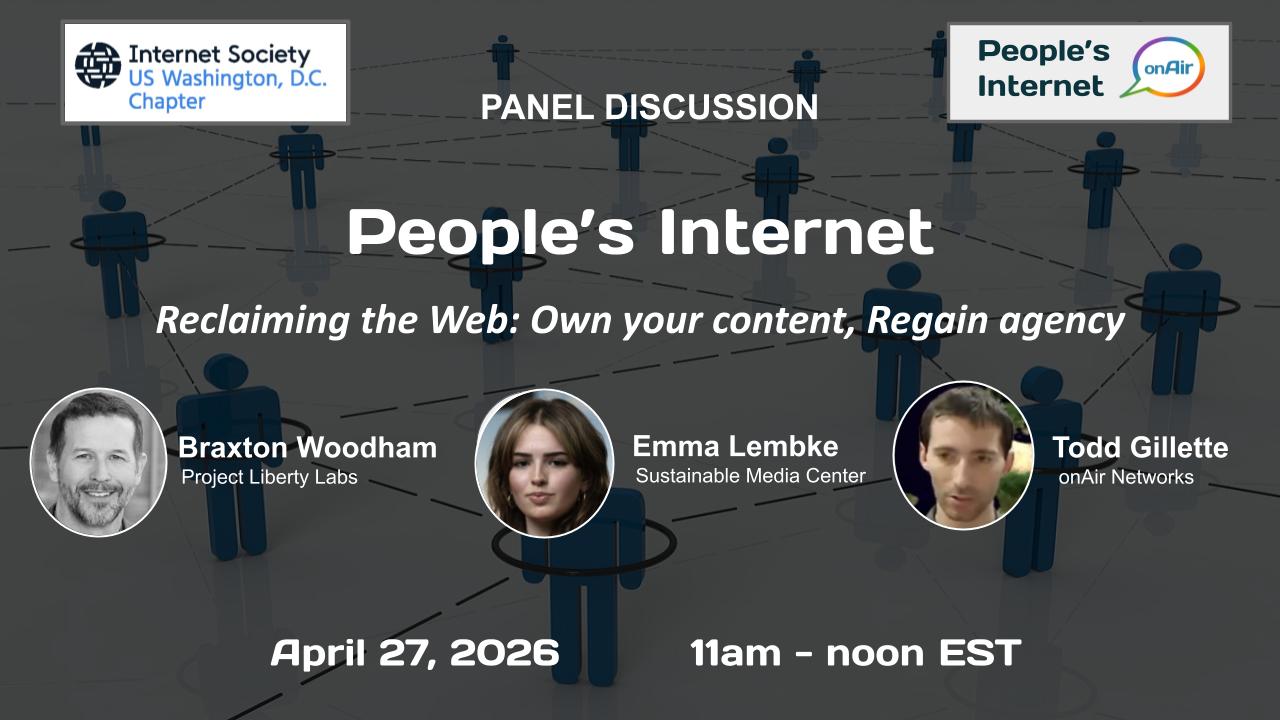
Proposed Panel for the ISOC chapters.

Bring together organizations who are promoting a user-centric Internet such as Project Liberty, Solid Protocol, Sustainable Media Center.

OnAir Post: Proposed Panel

Solid Protocol

Imagine having your own online storage, which you control. You store information once and decide who can access what, when you need services like mortgage applications or medical care.

This is what Solid can do. It’s a bit like carrying all your data in a rucksack (backpack) with lots of pockets. To access the data, different apps can only open the pocket you allow them to open, rather than taking the whole rucksack. The rest stays private.

Solid lets people take control of their data and combine it to achieve new results. It gives creators new collaborative tools while passing power back to users. It’s technology that returns the web to its original vision of serving people.

Source: Solid Website

OnAir Post: Solid Protocol

Tim Berners-Lee

Sir Tim Berners-Lee invented the World Wide Web while at CERN, the European Particle Physics Laboratory, in 1989. He wrote the first web client and server in 1990. His specifications of URIs, HTTP and HTML were refined as Web technology spread.

He is the co-founder and CTO of Inrupt.com, a tech start-up that uses, promotes and helps develop the open source Solid platform. Solid aims to give people control and agency over their data, questioning many assumptions about how the web has to work. Solid technically is a new level of standard at the web layer, which adds features never put into the original spec, such as global single sign-on, universal access control, and a universal data API so that any app can store data in any storage place. Socially Solid is a movement away from much of the issues with the current WWW, and toward a world in which users are in control, and empowered by large amounts of data, private, shared, and public.

Source: W3 Consortium

OnAir Post: Tim Berners-Lee

Project Liberty

Project Liberty builds solutions that advance human agency and flourishing in an AI-powered world.
The Project Liberty Institute is a nonprofit research and convening hub that advances democratic values and governance to shape a people-centered digital economy.

Technology: Frequency gives people control over their interactions with AI and social platforms.

Governance: Uniting frontier tech and policy to build a people-centered digital future.

Community:  Bringing together 150+ organizations to align AI and innovation with humanity’s interests.

Source: Project Liberty

OnAir Post: Project Liberty

Frank McCourt

Frank H. McCourt Jr. (born August 14, 1953) is an American business executive and philanthropist. As of 2023, he is the executive chairman and former CEO of McCourt Global, owner of the football club Marseille and founder and executive chairman of international non-profit Project Liberty.

In 2013, he donated $100 million to establish the McCourt School of Public Policy, the ninth school of Georgetown University. He made a second $100 million gift to Georgetown University in March 2021, for the express purpose of ensuring that “the McCourt School can open its doors more widely and build a pipeline of future public policy leaders that reflects the true diversity of our communities.”

In 2021, he founded the non-profit Project Liberty. The initiative has multiple components which includes the development of the Decentralized Social Networking Protocol (DSNP), the founding of the McCourt Institute with founding academic partners Georgetown University in Washington, D.C., and Sciences Po in Paris, and a network of partners within the Unfinished network.

In 2024, he announced plans to build a consortium to buy the US arm of TikTok.

Frank McCourt was featured in the December 19, 2024 US onAir news post titled: The Vision of Frank McCourt.

Source: Wikipedia

OnAir Post: Frank McCourt

Internet Society

Our Vision: The Internet Is for Everyone.

The Internet Society supports and promotes the development of the Internet as a global technical infrastructure, a resource to enrich people’s lives, and a force for good in society.

Our work aligns with our goals for the Internet to be open, globally connected, secure, and trustworthy. We seek collaboration with all who share these goals.

Together, we focus on:

  • Building and supporting the communities that make the Internet work
  • Advancing the development and application of Internet infrastructure, technologies, and open standards
  • Advocating for policy that is consistent with our view of the Internet

Source: Website

OnAir Post: Internet Society

Michelle De Mooy

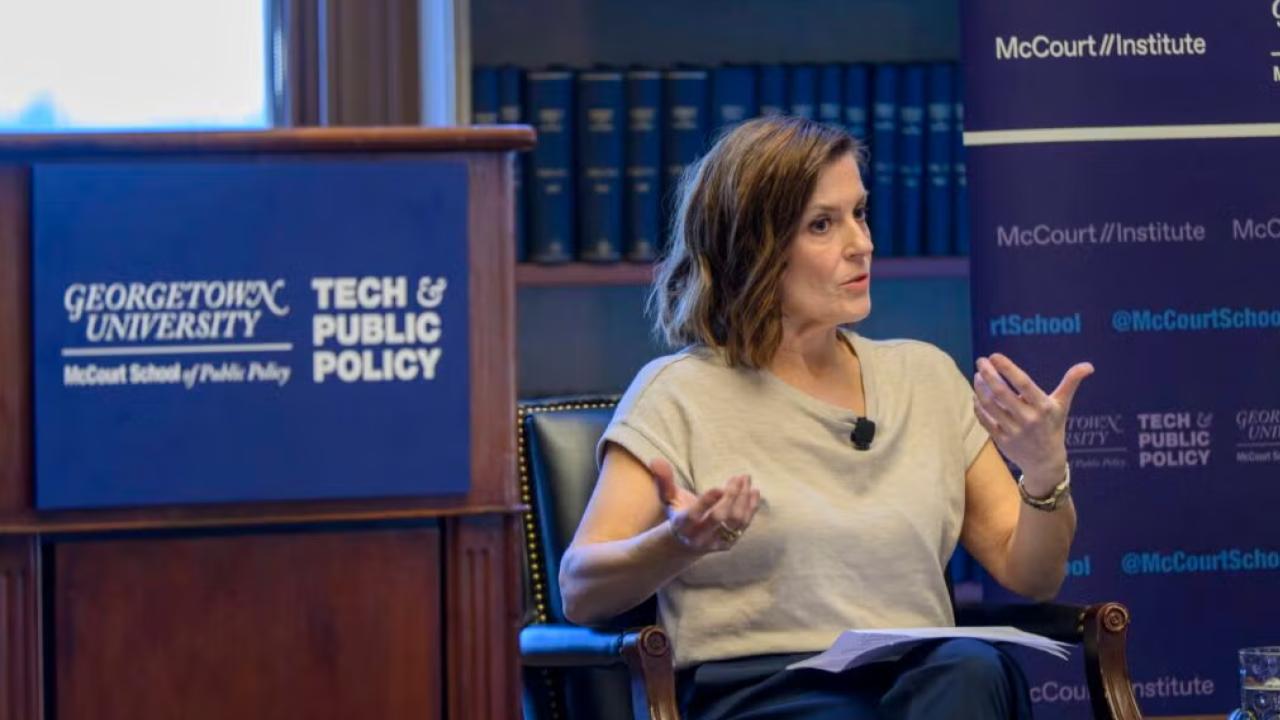
Michelle De Mooy is director of the Tech & Public Policy program in Georgetown University’s McCourt School of Public Policy. She is a leader in technology policy, focused on ensuring that emerging technologies advance human rights and democratic values.

For the Tech & Public Policy program, De Mooy is building initiatives that translate academic insights into actionable policy that drives impact. Current projects include innovative programming to reimagine policymaking, a partnership with a social media platform to provide access to data for Georgetown researchers and an AI Policy Lab.

Source: Tech & Public Policy website

OnAir Post: Michelle De Mooy

Skip to toolbar