Summary
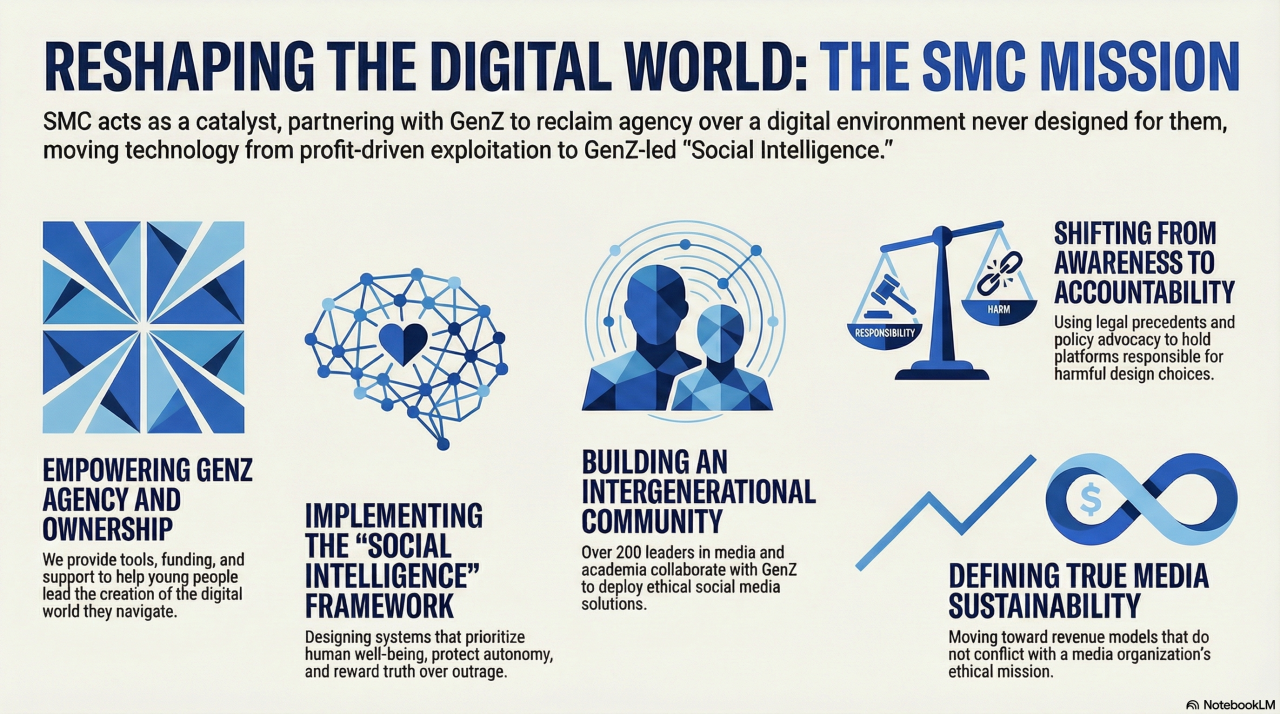
Our mission is to act as a catalyst for change—partnering with GenZ to give them agency over the digital world they navigate, create, and influence every day.
From social platforms to generative AI, today’s digital environment shapes how we connect, communicate, and understand what’s true.
We believe young people deserve more than protection—they deserve power.
Through tools, funding, and cross-generational support, we help GenZ lead the way—guided by a framework we call Social Intelligence: technology built with values, purpose, and human insight.
SustainableMedia.Center – 02/04/2026 (01:17:00)
This is a test of how NotebookLM can create a “brief video” from this SMC onAir post consisting of publicly available content… mostly sourced from SMC website and YouTube channel.
OnAir Post: Sustainable Media Center
News
For nearly three decades, Silicon Valley has relied on a simple legal defense when harm shows up on its platforms: “We didn’t create the content.”
That argument, grounded in Section 230 of the Communications Decency Act, has been one of the most effective liability shields in modern corporate history. It allowed platforms to scale at global speed while avoiding responsibility for what users post, share, and amplify. Lawsuits were routinely dismissed before they reached discovery. Executives rarely had to testify. The system worked.
What changed last week is not the statute. It’s the reality around it.
In K.G.M. v. Meta Platforms, Inc., et al., a Los Angeles jury found Meta and YouTube negligent in the design and operation of their platforms, concluding that those failures were a substantial factor in causing harm to a young user. The jury awarded $3 million in damages and assigned 70% responsibility to Meta and 30% to YouTube.
This was not a case about a single post. It was not a case about whether a platform failed to remove content quickly enough. It was a case about how the system itself works.
And the jury found that system wanting.
In this week’s Substack Live conversation, the Sustainable Media Center brings together Emma Lembke and theater creator Patrick McAndrew to explore an unexpected intersection: musical theater and responsible tech. McAndrew’s new production, The Startup, uses humor, storytelling, and live performance to examine some of the most urgent questions in tech today, including social media addiction, data privacy, and the ethical tensions inside startup culture.
The musical follows an idealistic tech company attempting to build a platform without exploiting user data, only to collide with the financial realities that drive today’s digital economy. Through its narrative and immersive audience experience, the show invites viewers to reflect on where the line between ethics and profit gets drawn and what is lost when it is crossed.
The conversation highlights a broader idea at the heart of SMC’s work: that culture, not just policy, can shape how we understand and challenge technology. By translating complex issues into human stories, The Startup aims to reach audiences who might never engage with these topics otherwise and leave them with questions that linger beyond the theater.
Ultimately, the goal is simple but ambitious. If even one audience member walks away thinking differently about their relationship with technology, the work has done its job.
My full-time job is fighting for tech accountability. As SMC’s Director of Gen Z Advocacy, that work has never felt more urgent. But I also have a deep passion for musical theater — and those two worlds rarely intersect. So when I discovered Patrick McAndrew’s The Startup, I was genuinely surprised, and genuinely thrilled.
Through sharp writing, humor, and original music, The Startup offers a compelling exploration of Big Tech’s influence — not just on society at large, but on our individual identities, relationships, and sense of agency. It’s the kind of project that leaves you questioning the platforms you use every day, while also reminding you of something we don’t talk about enough: storytelling is one of the most powerful tools we have for critique, reflection, and change. As someone who spends her days in policy briefs and platform accountability battles, I’ll admit I wasn’t expecting a musical to stop me in my tracks. This one did.
McAndrew’s journey with The Startup began nearly a decade ago. In 2016, after reading Sherry Turkle’s Reclaiming Conversation: The Power of Talk in a Digital Age, he began to more deeply interrogate the role technology was playing in our lives. What struck him most was not just the scale of digital influence, but its quiet reshaping of human connection — the way screens had begun to substitute for presence, and engagement metrics had begun to substitute for meaning.
Meta, YouTube found Negligent. Verdict in Social Media Harm Case brings Sustainable Media Center membership and mission to the fore.
“This verdict puts a stake in the ground. A jury reviewed how these systems are built and concluded that harm was not incidental. Profiting from misinformation just got a lot harder to do.”— Steven Rosenbaum, Executive Director, The Sustainable Media Center
NEW YORK, NY, UNITED STATES, March 26, 2026 / EINPresswire.com / — In K.G.M. v. Meta Platforms, Inc., et al., a Los Angeles jury found Meta and YouTube negligent in the design and operation of their platforms, concluding that those failures were a substantial factor in causing harm to a young user. The jury also found the companies failed to adequately warn users of known risks, awarding $3 million in damages and assigning 70 percent responsibility to Meta and 30 percent to YouTube.
The case, widely viewed as a bellwether, is the first to take claims of social media addiction and youth mental health harm to trial against major technology platforms.
The Sustainable Media Center, a nonprofit focused on building a healthier digital ecosystem, issued the following statement:
“This verdict puts a stake in the ground,” said Steven Rosenbaum, Executive Director of the Sustainable Media Center. “A jury reviewed how these systems are built and concluded that harm was not incidental. Profiting from misinformation just got a lot harder to do.”
Rosenbaum said the findings go directly to the core defense long used by platform companies.
“For years, the argument has been that platforms are passive, that they simply host what users bring to them,” he said. “This verdict rejects that. It recognizes that these systems are engineered environments, and that engineering carries responsibility.”
He added that the decision reframes how risk should be understood going forward.
“When a product is designed to maximize time, repetition, and emotional response, you can’t separate the design from the outcome,” Rosenbaum said. “That connection is now on the record in a court of law.”
SMC emphasized that the lived experience of young users is now being reflected in legal findings.
“What young people have been describing for years is now being validated in a different arena,” said Emma Lembke, Director of Gen Z Advocacy at the Sustainable Media Center. “This case acknowledges that these platforms don’t just host behavior, they shape it in ways that can have real consequences.”
Lembke said the ruling marks an inflection point.
“There’s a shift happening from awareness to accountability,” she said. “And once that shift happens, it becomes much harder for companies to dismiss harm as anecdotal or unavoidable.”
The Sustainable Media Center also recognized the families, advocates, journalists, and legal teams whose persistence helped bring the case forward.
SMC highlighted the work of the Social Media Victims Law Center and attorney Laura Marquez-Garrett, along with Nicki Petrossi, host of Scrolling 2 Death, who reported on the trial extensively, and Sarah Gardner of The Heat Initiative, and Lennon Torres, for their continued advocacy.
The organization paid tribute to Tony and Brandy Roberts, who lost their daughter Englyn Roberts and have become leading voices for families seeking accountability, along with the many parents who traveled to Los Angeles, waited for hours to enter the courtroom, and remained outside when they could not get in, determined to witness the proceedings.
“This outcome reflects years of persistence by families who refused to accept that nothing could be done,” Rosenbaum said. “They forced this issue into a place where evidence matters, and where responsibility can be assigned.”
SMC noted that the case is expected to shape how thousands of similar claims are evaluated across the country.
“This is the beginning of a new phase,” said Lembke. “Not the end of the conversation, but the point where it becomes much harder to ignore.”
Rosenbaum said the broader question now is what changes follow.
“The legal system has now weighed in on how these products operate,” he said. “The next step is whether that leads to meaningful changes in how they are designed, or whether it takes more cases, more pressure, and more public scrutiny to get there.”
In reporting the significance of this ruling, the New York Times wrote: “The cases have been compared to those against Big Tobacco last century, when Philip Morris and R.J. Reynolds were accused of hiding information about the harms of cigarettes. The companies reached a $206 billion master settlement with more than 40 states in 1998 that led to an agreement to stop marketing to minors. Strict tobacco regulations and a decline in smoking followed.”
Case Details:
Case: K.G.M. v. Meta Platforms, Inc., et al.
Court: Los Angeles County Superior Court, California
Case No.: JCCP 5255
Plaintiff’s Counsel:
The case was prosecuted by Mark Lanier of The Lanier Law Firm, along with the Social Media Victims Law Center and co-counsel including Laura Marquez-Garrett. 600 1st Ave Suite 102-PMB 2382, Seattle, WA 98104 Phone: (206) 741-4862
In this episode of the Sustainable Media Center’s Substack Live, Emma Lembke sits down with Gen Z board member and high school senior Raziya Palmer, a student at Success Academy High School of the Liberal Arts in Harlem, for a candid conversation about growing up in the age of AI and social media.
Raziya offers a grounded, firsthand perspective on how deeply AI has already been woven into student life. What began as a tool like ChatGPT has quickly become embedded across platforms, from search engines to schoolwork. While many students rely on AI to keep up with increasing academic pressure, Raziya raises concerns about what’s being lost: the ability to think critically, struggle through problems, and truly learn.
The conversation expands into the broader role of social media in Gen Z’s daily life. Raziya describes it as both addictive and essential, a space for connection and expression, but also one that shapes identity, attention, and even childhood itself. She points to a cultural shift where younger kids are skipping traditional developmental experiences, influenced instead by algorithm-driven content.
At the same time, she challenges a common assumption: that Gen Z is passively consumed by technology. Instead, she argues that many young people are acutely aware of the trade-offs. In fact, she suggests that older generations may be more vulnerable to AI-driven misinformation, lacking the digital instincts younger users have developed.
The episode closes on a note of balance and responsibility. Raziya calls for healthier tech habits among young people, encouraging a mix of digital and real-world engagement, while urging older generations to better understand the tools shaping their lives. Across both perspectives, one theme stands out: the future of technology isn’t just about innovation, it’s about how intentionally we choose to use it.
Maria Ressa does not issue warnings lightly.
She is a Nobel Peace Prize laureate, co-founder and CEO of the investigative newsroom Rappler, and one of the journalists who most clearly documented how social media gets weaponized against democratic institutions. For years she reported on the disinformation networks that helped consolidate power under Rodrigo Duterte in the Philippines — watching as coordinated online narratives discredited journalism, fractured public trust, and normalized violence against critics.
That experience is why her latest warning deserves careful attention.
The report is called “First 100 Days of Trump 2.0: Narrative Warfare and the Breakdown of Reality.” It was originally compiled in spring 2025 by The Nerve, a data insights consultancy Ressa helps lead as head of global strategy. The researchers analyzed executive orders, platform dynamics, influencer networks, and narrative patterns across Facebook, X, YouTube, and TikTok during the first hundred days of Donald Trump’s second term.
Then January 2026 arrived. And the researchers watched their framework play out in real time.
They added a preface — and released the report now.
“The chaos of those early months,” Ressa writes, “was not just political turbulence. It was the systematic importation and evolution of the authoritarian playbook we survived in the Philippines.”
The numbers behind that claim are striking.
Every year, SXSW feels a little different.
Some years it feels like a tech conference with music attached.
Some years it feels like a film festival that got invaded by startups.
And occasionally, it feels like the place where the future quietly shows up before anyone has fully figured out what it means.
This year felt like something else.
It felt like a festival standing at a crossroads.
The AI Conversation Has Arrived
For years, SXSW panels about technology carried a certain optimism. The tone was almost always forward looking. New tools, new platforms, new creators, new ways to connect.
This year the mood shifted.
I’ve met many champions in my life.
My father is a champion of the law. My high school English teacher was a champion of my education. And in 2024, I discovered a true champion for kids’ online safety: the Attorney General of New Mexico, Raúl Torrez.
Right now, if you scroll through social media looking for updates about the war involving Iran, the United States, and Israel, you will see an extraordinary amount of war footage.
Missiles streak across night skies. Drone footage shows explosions blooming across cities. Videos claim to show missile strikes in Tel Aviv or massive explosions in Gulf cities. The clips look and sound real, and they spread with astonishing speed.
But a growing number of them never happened at all.
Investigators and journalists tracking the information about the current conflict have documented waves of AI-generated videos, fabricated satellite images, and manipulated footage circulating online. Bellingcat and the Atlantic Council’s Digital Forensic Research Lab have flagged multiple viral clips — some accumulating tens of millions of views — as synthetic or recycled from entirely different conflicts.
What’s striking is not simply that these images exist. It’s that the tools required to create them are now widely available.
The messages started showing up in my feed late at night.
Friends posting from the Gulf. Someone in Dubai. Another in Abu Dhabi. A colleague working on a project in Riyadh. The tone was the same in each post: urgency mixed with disbelief.
“Flights are selling out.”
“Does anyone know which airlines are still flying?”
“I just bought three tickets hoping one of them gets me out.”
For years, the global expat world in the Middle East has operated on a quiet assumption. If something goes wrong, you can get on a plane. The airports in Dubai, Doha, and Abu Dhabi are among the busiest aviation hubs on earth. Flights leave constantly for Europe, Asia, and the United States.
Until suddenly they don’t.
As a member of Gen Z, I carry a deep concern for my generation, and I believe you should, too.
Since our infancy, we’ve been labeled many things: Gen Z, “screenagers,” digital natives, and, most troubling of all, the loneliest generation. Recent data shows that 73% of Gen Z report feeling alone sometimes or always. Loneliness is part of the human condition. But when nearly three-quarters of a generation report feeling persistently alone, we are not talking about normal adolescence. We are talking about a pattern.
I have lived the paradox of growing up constantly connected and profoundly isolated. I have felt what it is like to scroll for hours, surrounded by images of other people’s lives, while feeling increasingly distant from my own. I have felt the pressure to curate, to compare, to measure myself against bodies, lifestyles, and achievements filtered through an algorithm that decides what I see and how often I see it.
This is not abstract. It is daily life.
This week on Substack Live at the Sustainable Media Center, Emma Lembke sat down with Steve Rosenbaum and two of the most relentless voices tracking the Los Angeles social media harm trial in real time: Nicki Petrossi and Sarah Gardner.
Nicki is a digital activist and the host of Scrolling to Death and The Heat Is On. Sarah is the founder and CEO of The Heat Initiative and co-host of The Heat Is On. Together, they have become a daily signal in a media environment that is treating a historic trial like a niche story.
And that is the first big takeaway from this episode: the courtroom is full of evidence, testimony, and lived experience. The public conversation is not.
Sarah put it plainly. The reason they decided someone had to cover this case “day in and day out” is not just because it matters, but because we are hearing from the companies in a way we rarely do. When executives and lawyers speak under oath, when internal documents are put on screens, and when decisions get described in the language of product and profit, you learn how these companies actually think. Even when a moment does not land as a headline, it can still teach advocates how to apply pressure elsewhere.
That is what this coverage is: not commentary, but documentation.
It’s one thing to talk about platform harm in panels, reports, and headlines. It’s another to sit in a courtroom and watch the story of social media’s impact on young people get translated into legal arguments, evidentiary rules, and sworn testimony.
This week, Nicki Petrossi, host of the “Scrolling 2 Death” podcast, had one of the very scarce seats in the courtroom in Los Angeles as the first of the social media harms cases moved forward.
She wasn’t there for the optics. She has been tracking this space for years, following the shift from research and advocacy into litigation.
As Petrossi put it, when earlier policy efforts stalled, her focus changed: “I quickly realized, like, no matter what we do… we needed laws. We need help from our lawmakers to help protect our children from predatory companies.”
When that route failed to move quickly enough, she described a pivot toward the courts: “When that failed — for many different reasons… I realized, maybe lawsuits are where it’s at. Maybe some of these big legal tactics can make a difference.”
That is the context for why being in the courtroom now matters. This is not theoretical. This is the arena where product design choices, internal knowledge, and claims of responsibility get tested under oath. As Petrossi put it bluntly, “This is the first time that Mark Zuckerberg was under oath in a court of law having to answer questions about his company and what it does to kids. That is groundbreaking history.”
Sustainable Media Center Youtube, – February 23, 2026 (32:55)
About
Source: Website
Shaping platforms with purpose, tools with values, and a future GenZ can own. We call it Social Intelligence.
THE PROBLEM:
The digital world GenZ lives in wasn’t designed for them. It was built to maximize engagement, harvest data, and keep users hooked.
Today, social media feeds reward outrage. Algorithms amplify lies. AI is being trained to optimize those same incentives—faster, and with fewer guardrails.
The result? A system that profits from harm while young people carry the cost.
WHAT COMES NEXT?
Tools with values. Platforms with purpose. A digital future GenZ gets to shape—not just survive.
We call it Social Intelligence—a new framework for designing technology that puts people first. It’s about building systems that understand context, protect autonomy, and earn trust.
Not because it sounds good—but because GenZ deserves better than the world they’ve inherited.
Mission Statement
Our Mission Statement
Young people today want social media that connects and entertains without undermining their health and emotional well-being. We are growing an intergenerational community to explore, experiment, and deploy solutions that will give a new generation of media consumers and creators meaningful agency and ownership of their increasingly media-centric lives.
The Sustainable Media Center is a 501c3 organization formed by a diverse and inclusive board of over 200 leaders in media, technology and academia who want to foster and facilitate positive change to the current state of social media.
What Does Sustainable Media Mean?
Sustainability means meeting our own needs without compromising the ability of future generations to meet their own needs. Sustainability is not about the physical environment for media, it’s the social and economic resources we commit to the world of information and ideas that we live in.
The state of media today is not sustainable. It doesn’t sustain the health and well-being of our children, of our society, or our democracy. In its current incarnation, it profits from monetizing hate. We aim to build the future of sustainable media, to hold makers and distributors of media to be measured on a higher standard. A standard that doesn’t profit from knowingly doing harm.
Sustainable Media seeks a revenue stream that doesn’t put the media makers in conflict with their media’s ethical mission. So, for example, a news organization can’t be sustainable if the only way to remain solvent is to be paid by platform partners who facilitate and garner their revenue from amplification of misinformation, hate, or other anti-social community standards. If media companies’ underlying economic survival requires funds generated from platforms that make substantial revenue from amplification of misinformation, these media are not sustainable.
The State of Social Media Today
The state of social media today is not sustainable. It doesn’t sustain the health and well-being of our children, of our society, or our democracy. In its current incarnation, it profits from monetizing hate. We aim to build the future of sustainable media, to hold makers and distributors of media to be measured on a higher standard. A standard that doesn’t profit from knowingly doing harm.
Sustainability means meeting our own needs without compromising the ability of future generations to meet their own needs. Sustainability is not about the physical environment for media, it’s the social and economic resources we commit to the world of information and ideas that we live in.
Sustainable Media seeks a revenue stream that doesn’t put the media makers in conflict with their media’s ethical mission. So, for example, a news organization can’t be sustainable if the only way to remain solvent is to be paid by platform partners who facilitate and garner their revenue from amplification of misinformation, hate, or other anti-social community standards.
If media companies’ underlying economic survival requires funds generated from platforms that make substantial revenue from amplification of misinformation, these media are not sustainable.
Source: Website
Advisory Board Members
- Ahmed, Ziad
- Aibe, Sonja
- Andersen, Kurt
- Anderson, Mellisa
- Anderson, Kyle
- Angiuli, Duncan
- Aufderheide, Pat
- Bacigalupo, Tony
- Bahl, Tara
- Balaban, Sanda
- Balcone, Sacha
- Barber, Dawn
- Barujel, Luna
- Behar, Andrew
- Bennett, Robert
- Berens, Brad
- Berens, William
- Bergthold, Lara
- Berkowitz, David
- Bezos, Mark
- Boro, Cliff
- Bronfin, Ken
- Brown, Ted
- Brown, Tobacco
- Brown, Merrrill
- Burfield, Evan
- Carey, David
- Caruso, Brad
- Chalmbers, David
- Chen, Bing
- Christopher Johnson, Devon
- Clark, Jim
- Clavier, Bernadette
- Clinch, David
- Cohen, Brian
- Colborn, Hailey
- Conan, Katrina
- Conroy, Kevin
- Corin, Jaclyn
- Craig, Jiore
- Crowley, Denis
- Cullen, Lori
- Dalgaard, Connor
- DeBerry, Stephen
- DeWolf, Daniel
- Dyson, Esther
- Enriquez, Juan
- Ervin, Maia
- Fenster, Avalon
- Forer, Gil
- Foxx, Deja
- Galinski, Lara
- Garfield, Bob
- Geary, Joanna
- Geftman Gold, Ryan
- Geraldino, Duarte
- Gertler, Eric
- Gibbs, Lisa
- Gingras, Richard
- Glick, Isaiah
- Gloria, Kristine
- Godfrey, Missy
- Goldman, Rob
- Goldstein, David
- Gotsch, Maria
- Grayson, Rochelle
- Green, Robert
- Greene, Bob
- Gutin, Talia
- Hancock, Katya
- Hasson, Uri
- Helms, Colin
- Hindrey, Leo
- Hollifield, Ann
- Hollis, Mya
- Hornik, David
- Horowitz, Bradley
- Jackson, Tea
- Jones, Kathryn
- Julliana, Olivia
- Kedia, Pankaj
- Kee, Tameka
- Kirschner, Ann
- Klein, Jason
- Knell, Gary
- Koch, Kristin
- Kohn Murphy, Aidan
- Krantz, Gary
- Leiner, Ben
- Lessig, Larry
- Lieberman, Mark
- Lo, Isabel
- Louderback, Jim
- Lubin, Nathaniel
- Lukasiewicz, Mark
- Magnus Ogunnaike, Jade
- Marcus, Gary
- McNamee, Roger
- Merrifield, Lane
- Miller, Jon
- Miranda, Ricardo
- Mirsky, Israel
- Morrisett, Greg
- Murad, Aida
- Muthukumar, Mukilan
- Narvaja, Rhonamyr
- Oconner, Rory
- Ohakamma, Isabel
- Ongele, Sophia
- Osder, Elizabeth
- Palfrey, John
- Palmer, Raziya
- Pang, Angela
- Parks, Craig
- Peoples, Clarke
- Pergaman, Andrew
- Perry, Sam
- Peymani, Keyvan
- Pinto, Chelsea
- Prohaska, Matt
- Prohaska, Matt
- Quint, Matthew
- Qureshi, Zamaan
- Rainie, Lee
- Rhee, James
- Rogers, Danny
- Roman, Robert
- Rose, Frank
- Rose, John
- Rosenbaum, Steve
- Rosensteil, Tom
- S. Rose, David
- Sarnoff, Rus
- Sarva, Amol
- Savar, Avi
- Scelfo, Julie
- Schiffrin, Anya
- Schultte, Drew
- Schultz, Xander
- Scordato, Alexa
- Seave, Ava
- Sergey, Richard
- Sernovitz, Andy
- Shapiro, Evan
- Shimshowitz, Dror
- Silver, Noelle
- Spanfeller, Jim
- Stein, Lara
- Stelter, Brian
- Steltzer, Olivia
- Stengle, Richard
- Stivers, Cyndi
- Strauss, Steven
- Stuntz, Mayo
- Sweet, Dr. David
- Taplin, Jonathan
- Tercek, Robert
- Thione, Lorenzo
- Thurston, Baratunde
- Tobaccowala, Rishad
- Trauberman, Hannah
- Troesken, Dylan
- Turkle, Sherry
- Turquoise Robinson, Evita
- Tusk, Bradley
- Van Bavel, Jay
- Vein, Jon
- Walsh, Mark
- Wassong, Kevin
- Wheeler, Mike
- Winch, Guy
- Zigman, Michael
Source: Website
Contact
Email: Email
Web Links
Videos
Gen Z on AI, Social Media, and the Fight to Think for Ourselves
March 23, 2026 (18:12)
By: SustainableMedia.Center
SXSW Truth Under Fire: AI, Reality, and the Fight for What’s Real Talk 3:17:26
March 20, 2026 (46:15)
By: SustainableMedia.Center
At SXSW, Steven Rosenbaum takes on one of the biggest questions of our time: what happens when AI makes reality cheap, scalable, and increasingly hard to trust? Drawing on stories from magic, Plato’s cave, The Matrix, journalism, law, love, work, and politics, he argues that we are not just facing a misinformation problem. We are living through a deeper crisis in which proof is easier to fake, certainty is easier to sell, and the systems shaping our lives are optimized for engagement, speed, and profit, not truth.
Rosenbaum explores how AI-generated content, algorithmic authority, and platform incentives are changing the way we understand news, justice, intimacy, and democracy itself. His core warning is simple but urgent: when people no longer know they are watching a trick, the social contract breaks. And when proof becomes cheap, truth becomes expensive.
But this is not a doom talk. It is a call to action. Rosenbaum argues that truth is not dead, and we are not powerless. If we learn to question incentives, resist machine certainty, protect human friction, and stay engaged in the messy work of judgment, we can still shape a future in which truth survives. As he puts it, truth is not something delivered to us. Truth is something we do.
SMC Board of NextGen Advisors – v5
August 10, 2023 (01:07)
By: SustainableMedia.Center
Cory Booker + GenZ – Roundtable Conversation
(01:17:00)
By: SustainableMedia.Center
00:00 Popcorn Intro’s
4:04 Steven Rosenbaum, Exec Director, The Sustainable Media Center
5:05 Aidan Kohn-Murphy – Moderator / Founder GenZ For Change /SMC Next Gen Board
11:39 Sophia Ongele, SMC Next Gen Board, genzforchange
17:45 Maia Ervin, Chief Impact Officer, JUV Consulting
29:23 Sabine Lawrence, isdGlobal.org
33:29 Zamaan Qureshi, SMC Next Gen Board, Co-Chair | Design It For Us
40:51 Arden P. B. Wiese, Stanford University
45:34 Kyle Anderson, Fusion Academy Evanston, 11th Grade (Junior)
50:00 Avalon Fenster, SMC Next Gen Board, Barnard College
1:01:19 Mukilan Muthukumar – YVote, Senior at Hunter College High School
1:05:46 Hannah Trauberman, Student, NYC
1:03:22 Sonja Aibel, YVote, Brooklyn Technical High School senior,
1:11:02 Olivia Steltzer, SMC Next Gen Boad, Cramm The News
1:14:23 Connor Dalgaard, SMC Next Gen Board, Youth Mental Health Activist
Research
Source: Other
The Future of Social Media: There is Hope
By Kendall Schrohe | In collaboration with the Sustainable Media Center and Accountable Tech | 2025
This research explores a fast-growing ecosystem of ethical, decentralized, and community-centered social media alternatives emerging beyond the reach of Big Tech.
Research Context
Conventional wisdom suggests that Meta, Google, TikTok, X, and Snap have an unshakeable hold on the social media landscape. Yet a new ecosystem is emerging—one that values authenticity, privacy, and human connection over engagement metrics and data extraction.
Executive Summary
This report identifies over 135 alternative social platforms, analyzing 67 in depth. These projects span decentralized architectures, ethical monetization, and healthier design principles that challenge the dominance of mainstream platforms.
- Fediverse: Open, interoperable social networks like Mastodon, Pixelfed, and PeerTube.
- Decentralized & Ethical: User-sovereign systems such as Bluesky, Vero, MeWe, and Sparkable.
- Healthier-by-Design: Apps like Retro, Minus, and Cosmos that use design limits to encourage mindful engagement.
- Inclusive Platforms: Community-first networks like Lex, Diem, and Sunroom that prioritize safety and representation.
- Child-Safe Platforms: Spaces like Zigazoo and Coverstar that demonstrate safe digital creation for kids.
Methodology
Platforms were evaluated across six criteria:
- Technological architecture
- Business model
- Design and values
- Target demographic
- Stage of development
- Community size and impact
Data was collected from platform documentation, interviews, and first-hand testing of select apps.
Findings: Categories of Alternative Social Media
1. Fediverse Platforms
The Fediverse uses open standards (notably ActivityPub) to connect independent communities across platforms. Examples include Mastodon, Pixelfed, PeerTube, and Mobilizon. Each allows local moderation while remaining globally interoperable.
2. Decentralized and Ethical Platforms
Projects like Bluesky, MeWe, Pools, and Vero emphasize user control, privacy, and sustainability. Many operate ad-free or rely on community funding instead of surveillance advertising.
3. Healthier-by-Design Platforms
Retro, Minus, Cosmos, Foto, and Joinable adopt features that discourage addiction: limited posting, delayed feedback, or prompts for offline connection.
4. Innovative and Conceptual Platforms
Slowly, Corner, TimeLeft, and Perfectly Imperfect reimagine social interaction itself—using slower communication, spatial storytelling, or serendipitous discovery instead of endless feeds.
5. Inclusive Social Platforms
Platforms like Diem, Lex, Spoony, and Communia were built for users who are often marginalized or unsafe in mainstream networks, emphasizing community care and identity visibility.
6. Platforms for Children
Zigazoo and Coverstar demonstrate that kid-friendly, moderated social experiences are possible without engagement-based algorithms or invasive data collection.
Analysis and Conclusions
Three major themes emerged from the research:
- Business Model Innovation: A growing shift toward subscriptions, grants, cooperatives, and revenue sharing that breaks from the ad-based economy.
- Technical Decentralization: Open protocols like ActivityPub and AT Protocol enable interoperability and data mobility.
- Value-Based Design: Mental health, inclusivity, and digital well-being are foundational—not afterthoughts.
While many platforms remain small, their collective innovation signals a cultural shift away from surveillance capitalism toward digital spaces rooted in trust and autonomy.
Recommendations for Further Research
- Long-term studies on user well-being and engagement in ethical platforms.
- Policy frameworks that promote platform diversity.
- Funding models for decentralized moderation and safety infrastructure.
- Interoperability standards across next-gen networks.
About the Team
Kendall Schrohe is a digital researcher, youth activist, and Gen Z technologist focused on ethical design and online well-being. She serves on the Gen Z Board of Advisors at the Sustainable Media Center.
Sustainable Media Center (SMC): A nonprofit think-and-do tank building a healthier, more sustainable information ecosystem. sustainablemedia.center
Accountable Tech: A nonprofit advocacy group working to curb the harms of Big Tech and promote a safer digital future. accountabletech.org
Appendix: Complete Platform List
The research identified 135+ alternative platforms across categories including Fediverse, decentralized social, healthier-by-design, inclusive communities, and children’s networks. A downloadable CSV or PDF of the complete dataset is available from the Sustainable Media Center.
Alternative Social Media Platforms (PDF)
Source: Website
Sponsors and Partners
Source: Other
We can’t drive change alone. Meet our fellow travelers:
- Quantum Media
- Craig Newmark Philanthropies
- Mintz
- Design It For Us
- US News & World Report
- Gen-Z for Change
- Log Off
- Accountable tech
- Global Disinformation Index
- Vote Y
- Public Good
- Business Technology: Early College High School
- GO Media
- Canva
- ADL
- Color of Change
- Suzy
- Project Liberty
- Unfinished
- iGeneration Youth
- ESHAP
NotebookLM Experiments
These are tests of how NotebookLM can create different media from this SMC onAir post consisting of publicly available content… mostly sourced from SMC website and YouTube channel.
Infographic
Brief Report
The State of Sustainable Media and Digital Agency: A Briefing DocumentExecutive Summary
The digital landscape is currently at a critical inflection point, shifting from a period of unregulated platform growth to an era of legal accountability and youth-led advocacy. The Sustainable Media Center (SMC) identifies the current social media model as inherently “unsustainable,” arguing that systems built to maximize engagement through outrage and misinformation cause measurable harm to democracy and youth mental health.
Key developments include a landmark 2026 legal verdict in K.G.M. v. Meta Platforms, Inc., which found major tech platforms negligent in their design, effectively challenging the long-standing “liability shield” of Section 230. Simultaneously, a growing ecosystem of over 135 alternative, decentralized, and “healthier-by-design” platforms is emerging to challenge the dominance of Big Tech. The mission of the SMC is to foster “Social Intelligence”—a framework where technology is built with human values and purpose, granting Generation Z agency over their digital lives rather than just protection from them.
——————————————————————————–
I. The Framework of Social Intelligence and Sustainability
The Sustainable Media Center defines its core mission as a catalyst for change, specifically focusing on empowering Gen Z to navigate and influence the digital world.
Defining Sustainability in Media
- Resource Management: Sustainability is defined not by the physical environment, but by the social and economic resources committed to the world of information and ideas.
- Intergenerational Equity: Meeting current digital needs without compromising the ability of future generations to meet theirs.
- Ethical Revenue Streams: A sustainable media entity must have a revenue model that does not conflict with its ethical mission. Media companies reliant on platforms that profit from the amplification of hate or misinformation are deemed unsustainable.
Social Intelligence
SMC proposes “Social Intelligence” as a new design framework. This involves building technology that:
- Prioritizes human insight and purpose over engagement metrics.
- Protects user autonomy.
- Understands context and earns trust.
- Moves beyond “protecting” young people to giving them “power” and agency.
——————————————————————————–
II. Legal Accountability and the “Death” of the Passive Platform
A significant shift in the legal landscape occurred in March 2026, marking what observers call an inflection point for tech accountability.
K.G.M. v. Meta Platforms, Inc.
In a landmark case in Los Angeles Superior Court, a jury found Meta and YouTube negligent in the design and operation of their platforms.
- The Verdict: The jury awarded $3 million in damages, assigning 70% responsibility to Meta and 30% to YouTube.
- Key Finding: The harm was not found to be incidental but a result of how the systems were engineered. The jury concluded these platforms failed to warn users of known risks related to addiction and mental health.
- The End of Passive Defense: For decades, Section 230 of the Communications Decency Act allowed platforms to argue they were passive hosts. This verdict rejects that premise, recognizing platforms as “engineered environments” where design choices carry responsibility.
Comparisons to Big Tobacco
The legal proceedings against Big Tech have been compared to the 20th-century litigation against Philip Morris and R.J. Reynolds. The 1998 master settlement with tobacco companies led to strict regulations and the end of marketing to minors; advocates suggest social media is entering a similar phase of systemic regulation.
——————————————————————————–
III. The Gen Z Experience: Loneliness and Digital Agency
Gen Z is frequently characterized as the “loneliest generation,” with 73% reporting they feel alone sometimes or always. The SMC argues this is a structural result of digital design rather than a personal failing.
The Paradox of Connectivity
- Isolated Connection: Young users describe a “paradox” of being constantly connected through screens while feeling profoundly isolated from themselves and others.
- Algorithmic Pressure: Users face constant pressure to curate identities and compare themselves against filtered, algorithmically driven standards.
- The “Experiment” Generation: Advocates argue that Gen Z has been an involuntary experiment for engagement-based algorithms that reward outrage and addictive behavior.
AI and Critical Thinking
Gen Z voices, such as Raziya Palmer, highlight the impact of AI (e.g., ChatGPT) on education. While these tools help students manage academic pressure, there is a rising concern that they undermine the ability to:
- Think critically.
- Struggle through complex problems.
- Engage in authentic learning.
——————————————————————————–
IV. The Erosion of Reality: AI and Narrative Warfare
Technological advancements in AI have created a “crisis of proof,” where reality is becoming cheap, scalable, and difficult to verify.
Synthetic Conflict Documentation
In recent conflicts involving the U.S., Israel, and Iran, investigators (including Bellingcat and the Atlantic Council) have documented:
- Waves of AI-generated war footage and fabricated satellite images.
- Viral clips accumulating tens of millions of views that are entirely synthetic or recycled from previous conflicts.
- The wide availability of tools that allow anyone to create convincing fakes, breaking the social contract of shared reality.
Narrative Warfare
Nobel laureate Maria Ressa has warned of a “war on reality,” documenting how social media is weaponized by authoritarian playbooks to:
- Discredit journalism.
- Fracture public trust.
- Normalize violence through coordinated online narratives.
——————————————————————————–
V. Emerging Alternatives: The Future of Social Media
Research conducted by Kendall Schrohe in collaboration with SMC identifies a growing ecosystem of over 135 alternative platforms that prioritize ethics and privacy over data extraction.
| Category | Characteristics | Examples |
|---|---|---|
| Fediverse | Open, interoperable networks using ActivityPub; local moderation. | Mastodon, Pixelfed, PeerTube |
| Decentralized | User-sovereign systems; privacy-focused; ad-free models. | Bluesky, Vero, MeWe |
| Healthier-by-Design | Use design limits (limited posting/delayed feedback) to curb addiction. | Retro, Minus, Cosmos |
| Inclusive Platforms | Built for marginalized groups; prioritize community care. | Lex, Diem, Sunroom |
| Child-Safe | Moderated experiences without engagement algorithms. | Zigazoo, Coverstar |
Shift in Business Models
The emerging “Next-Gen” networks are moving away from surveillance advertising toward:
- Subscription models.
- Grants and cooperatives.
- Revenue sharing with creators.
——————————————————————————–
VI. Cultural Interventions: Storytelling as Critique
The SMC emphasizes that policy alone cannot change the digital landscape; culture must play a role in reshaping our relationship with technology.
- The Startup (Musical): Created by Patrick McAndrew, this production uses theater to examine social media addiction and data privacy. It illustrates the tension between ethics and profit in startup culture, using storytelling to reach audiences who may not engage with policy briefs.
- Documentation as Advocacy: Programs like “Scrolling 2 Death” and “The Heat Is On” provide daily documentation of legal trials and corporate testimony, ensuring that internal platform decisions are made public and preserved as evidence for future advocacy.
——————————————————————————–
VII. Organizational Leadership
The Sustainable Media Center is supported by a diverse advisory board of over 200 leaders across media, technology, and academia.
- Executive Leadership: Steven Rosenbaum (Executive Director), Emma Lembke (Director of Gen Z Advocacy).
- NextGen Board Members: Includes Aidan Kohn-Murphy, Sophia Ongele, Zamaan Qureshi, and Avalon Fenster.
- Key Partners: Craig Newmark Philanthropies, Gen-Z for Change, Accountable Tech, and various academic and legal organizations.