Summary
Project Liberty builds solutions that advance human agency and flourishing in an AI-powered world.
The Project Liberty Institute is a nonprofit research and convening hub that advances democratic values and governance to shape a people-centered digital economy.
Technology: Frequency gives people control over their interactions with AI and social platforms.
Governance: Uniting frontier tech and policy to build a people-centered digital future.
Community: Bringing together 150+ organizations to align AI and innovation with humanity’s interests.
Source: Project Liberty
Project Liberty – 07/04/2025 (01:00)
Project Liberty is stitching together an ecosystem of technologists, academics, policymakers, and citizens committed to building a better internet—where the data is ours to manage, the platforms are ours to govern, and the power is ours to reclaim.
OnAir Post: Project Liberty
News
Georgetown University – June 30, 2026
WASHINGTON, D.C. — The Tech & Public Policy Center (TPP) at Georgetown University’s McCourt School of Public Policy today announced nine new research grants supporting faculty-led projects that examine how artificial intelligence and emerging technologies are reshaping public life. The awards fund work spanning criminal justice, health care, education, global governance and democratic participation, reflecting the center’s mission to serve as a catalyst for emerging issues in technology policy.
“These grants move beyond abstract debates about AI to examine how these technologies are actually being deployed, who they affect, and what guardrails are needed,” said Carole Roan Gresenz, Dean of the McCourt School of Public Policy. “Our faculty are uniquely positioned to bridge the gap between technical innovation and sound public policy.”
The funded projects span three broad themes: understanding how AI systems operate within public institutions, examining public attitudes and online behaviors in an era of algorithmic influence and evaluating regulatory and governance frameworks for emerging technologies.
In 1871 the Meiji government sent officials and scholars abroad. The party visited the United States and Europe. Its task was practical: inspect institutions, factories, schools, ports, armies, and courts; record what could be copied; report what could be adapted; return with usable knowledge. Japan’s leaders had reached a hard conclusion. Industrial powers had acquired new productive capacity, new weapons, new transport, and new administrative competence. A preindustrial state could not protect its independence against countries that had mastered these tools.
The results were rapid. Japan reorganized education, industry, finance, transport, and state administration. By 1905 it defeated Russia. Between 1913 and 1938 its industrial production increased more than fivefold. Britain, once the early industrial leader, rose far more slowly in the same period. The lesson was not that machines alone make history. The lesson was that societies either reorganize around a new technology or become evidence in someone else’s archive.
Of course, that is a simplification, it is too tidy, and history is seldom tidy except in retrospect! Yet the evidence is stubborn. A technological revolution is never only a technical event. It is an audit of a civilization. It asks whether schools still educate, whether institutions still work, whether citizens still trust one another enough to act together, whether ambition has become vanity, and whether public language can still carry truth without collapsing under the weight of slogans, advertisements, and professional evasions.
Everybody’s talking about agentic AI. But what about agentic humans?
We’re being promised agency by those who are pushing AI. But as usual, the people selling it are the ones defining the terms. Here’s what they mean: you’re able to do more stuff. You can write faster and code better and analyze more, and ultimately produce more.
That’s not agency. That’s capability. Not a bad thing, but those are different words for a reason.
What the AI companies want us to see is just one axis: capabilities. Move out to the right, do more stuff. But there’s another axis, power, and we are not moving along that one at all.
Sustainable Media Center Youtube, – June 29, 2026 (21:05)
After the Memorials: Parents Say Congress Is About to Get Kids’ Online Safety Wrong
The day after Social Media Victims Remembrance Day, the conversation shifted from remembrance to accountability.
On this week’s Sustainable Media Center Substack Live, Emma Lembke spoke with Amy Neville and Kristin Bride, two mothers whose sons died from harms connected to social media. Their losses were different. Their mission has become the same.
Both women have spent years walking the halls of Congress, meeting with lawmakers, speaking in schools, supporting families, and pushing technology companies to build products that put children’s safety ahead of engagement and profit.
But this conversation came at a particularly consequential moment.
As Congress considers the latest version of the Kids Act, both advocates argue that lawmakers are moving in exactly the wrong direction.
Kristin Bride didn’t mince words.
“This is not a bill that protects kids and American families. It protects Big Tech.”
For years, parents and youth advocates fought for legislation built around a simple principle: if companies knowingly design products that harm children, they should have a legal duty to prevent those harms.
That “duty of care” was at the heart of earlier versions of the Kids Online Safety Act.
According to Bride and Neville, the current House proposal removes that protection while making it harder for families to seek justice in court.
The irony, they argue, is impossible to ignore.
The legal system has become one of the only forces that has actually changed company behavior.
Bride pointed to her lawsuit against Snapchat and the anonymous apps YOLO and LMK. She noted that the day after the lawsuit was filed, Snapchat removed the anonymous apps from its platform.
“It took my son dying and a lawsuit to make that happen.”
For both women, litigation has become one of the few mechanisms capable of forcing meaningful safety changes. Weakening families’ ability to sue, they argue, removes one of the only incentives companies have to redesign dangerous products.
Their criticism wasn’t reserved for Washington.
Asked how social media companies have responded to families over the past several years, neither saw meaningful progress.
Amy Neville described many recent safety features as cosmetic rather than substantive.
Teen accounts, parental dashboards, and voluntary safety tools, she argued, do little to address platforms fundamentally designed around engagement rather than child protection.
“Until they make it safe by design, they are doing nothing.”
Still, there were signs of progress.
Both advocates agreed that lawmakers today understand technology far better than they did four years ago. Congressional staff increasingly include young adults who grew up with Snapchat, anonymous apps, algorithmic feeds, and online harassment. Many have lived these experiences themselves.
That generational shift matters.
It also mirrors one of the Sustainable Media Center’s central ideas: solving technology’s biggest problems requires an intergenerational movement.
Throughout the discussion, Emma Lembke emphasized that the most effective advocacy brings together parents, survivors, researchers, and young people who have lived through these systems.
Bride agreed.
Some of the most powerful meetings on Capitol Hill, she said, are those where parent survivors sit beside youth advocates.
Together, they represent both the children who were lost and the generation still living with these products every day.
Perhaps the most revealing question came near the end of the conversation.
If they could spend a day with every social media CEO, what would they ask?
Bride wished executives would imagine their own children using the products they build.
Neville went further.
She proposed an “Undercover Boss” experience, where executives would spend a week alongside teenagers navigating today’s online world, seeing firsthand the bullying, exploitation, extortion, drug sales, and manipulation that have become routine experiences for too many young users.
Maybe then, she suggested, empathy would become part of product design.
Despite years of setbacks, neither mother sounded defeated.
Both pointed to something that didn’t exist six years ago.
There is now a national movement.
Organizations, youth advocates, researchers, families, and lawmakers are working together in ways that would have been unimaginable when their sons died.
Public awareness has shifted dramatically.
Parents now routinely delay smartphones and social media.
Schools are reconsidering phone policies.
Young people themselves increasingly recognize that these platforms are shaping mental health, relationships, and childhood.
For both women, that growing awareness is what keeps them going.
Social Media Victims Remembrance Day honors children who are no longer here.
But as this conversation made clear, it is also becoming something else.
A growing movement determined to make sure fewer families have to create memorials of their own.
Never get in the way of a parent on a mission.
Most never expected to have one. They were busy raising their children, building careers, getting on with life. Then a problem reached their child and became impossible to ignore. They stepped forward because someone had to, and once they did, there was no stepping back.
I’ve spent the last several years at Project Liberty working alongside organizations committed to building a healthier digital future. Over these years, my son moved from first grade into early adolescence, navigating new questions about independence, friendship, and what it means to grow up online.
As Executive Director of the Project Liberty Alliance, I meet parent advocates every week. They run nonprofits, organize neighbors, lobby legislators, and walk other families through a tech landscape that keeps shifting underfoot. Their careers and politics often have little in common. Yet they land in the same room because a problem reached their family, and they responded with purpose.
They join a long line of parents who saw something wrong and refused to wait for someone else to fix it.
Project Liberty Institute – June 15, 2026
On June 11, 2026, the OECD and its Global Partnership on AI (GPAI) invited Project Liberty Institute to present insights from its global work engaging limited partners and venture capital firms on responsible AI investing.
The invitation reflects the growing recognition that private markets will play an important role in shaping the future of AI. Over the past three years, Project Liberty Institute, together with partners including Reframe Venture, ImpactVC, Omidyar Network, UN B-Tech and others, has engaged more than 200 LPs and VCs representing over $6 trillion in capital across Europe, North America and Asia to advance how investors are navigating both the risks and opportunities associated with AI.
At a moment when the OECD and GPAI are considering how to translate the OECD AI Principles and emerging international standards, including the G7 Hiroshima AI Process, into practical guidance for investors, they convened perspectives from across the investment ecosystem. Project Liberty Institute’s Senior Director of Policy, Investment & Innovation, Paul Fehlinger, joined Sophie Walker, who leads responsible AI at EQT, one of the world’s largest private markets investors, and Laurie Fitzjohn-Sykes of Omidyar Network to explore what drives investor decision-making on AI.
A central insight emerging from this work is that investors increasingly recognize the material risks associated with AI and the need to strengthen due diligence, governance and stewardship practices. At the same time, they are asking a complementary question: what should they invest towards?
For years, critics of social media were dismissed as alarmists. Today, juries are finding major platforms liable for harm, lawmakers are paying attention, and a new generation is questioning whether the internet they inherited is the one they want to keep.
In this week’s Substack Live, Steven Rosenbaum sits down with former Facebook Elections Integrity lead Yael Eisenstat, Wired Human’s Maya Inglehorn, and democracy advocate Imre Huss to ask a deceptively simple question:
Are things finally getting better, or are they getting worse?
The conversation ranges from the landmark social media liability cases in Los Angeles and New Mexico to the rise of AI, algorithmic manipulation, digital autonomy, and the growing demand for healthier online spaces.
Along the way, the panel wrestles with a harder question: if social media shaped the last decade, what happens when AI becomes embedded in everything we do?
A candid conversation about accountability, democracy, technology, and whether the next generation can build something better than what came before.
This week on SMC’s Substack Live, Emma Lembke and I were joined by two extraordinary advocates: Tony Roberts and Trisha Prabhu.
Tony became part of this movement after the loss of his daughter, England. Trisha’s work began when she experienced cyberbullying as a young teenager and decided to build something better.
What followed was one of the most honest conversations we’ve had about the gap between what parents think is happening online and what many young people are actually experiencing.
Tony spoke about seeing only the surface of social media through his daughter’s eyes. Trisha shared why so many young people never tell their parents when things go wrong online. Together, they explored the growing frustration with the lack of action from Washington, the promise of state-level reforms, and the role young people are increasingly playing in demanding change.
One theme surfaced again and again throughout the discussion: awareness is no longer the problem.
Parents, teachers, and students know. The question now is whether institutions can move fast enough to match the urgency families are already feeling.
It’s a powerful conversation, and one we’re grateful to share with the SMC community.
Project Liberty Substack – June 16, 2026
“For the first time in human history, we have a technology that can generate words separately from the thoughts they represent.”
Rebecca Winthrop wrote those words in a recent New York Times op-ed on AI and creativity. Winthrop, a senior fellow and director of the Center for Universal Education at the Brookings Institution, researches education and the skills young people need to thrive in work, life, and as constructive citizens.
There is a growing body of research to show how AI homogenizes human creativity, where people become estranged from their own thoughts, and AI erodes the very judgment we will need to set its limits.
In this newsletter, we consider the relationship between thinking and writing, and whether technological advances spell the end of creativity, or just shift its frontier.
Pope Leo XIV made headlines last month with his 42,000-word encyclical, “Magnifica Humanitas”, but he is not the only faith leader weighing in with perspectives on AI.
Leaders from Islam, Hinduism, Buddhism, the Church of Jesus Christ of Latter-day Saints, and many other religious and spiritual traditions have shared wisdom about how their communities might consider living with and shaping this technology.
Last week, Project Liberty President Tomicah Tillemann shared five of his reflections on the Pope’s encyclical. This week, we’re exploring whether AI can spark a fractured religious world to speak with a united voice about the most consequential technology of our generation.
Pope Leo XIV signed his encyclical on AI, “Magnifica Humanitas” (“Magnificent Humanity”), 135 years to the day after another Pope Leo published “Rerum Novarum” (“Of New Things”) in 1891. The earlier document has provided the foundation for the Catholic church’s social doctrine, and the latest encyclical could be equally consequential.
The two letters touched on similar themes: power, greed, technological change, and the need to center human dignity when concentrated power shapes how technology develops.
- The work of Pope Leo XIII, “Rerum Novarum,” advocated for protecting workers amid the turmoil of the 19th-century industrial revolution.
- “Magnifica Humanitas” lays out a human-centered vision for the age of artificial intelligence, and explicitly calls for the technology to advance the goals of human flourishing and agency.
Robert Prevost, the Pope’s given name, has been thinking about AI for some time. He chose the name Leo because it was “a clear reference to the modern social doctrine of the Church, which began with Rerum Novarum,” a Vatican spokesperson said in 2025. It was a reference to “men, women, their work, and workers in an age of artificial intelligence.”
Project Liberty Institute – May 29, 2026
The EU Commission DG CNECT and Project Liberty Institute convenes European builders and experts to shape the future of innovation in Europe
Participants at the EU Commission DG CNECT and Project Liberty Institute workshop on human-centered data ecosystems in Brussels.
The workshop “Enabling Human-Centered Data Ecosystems: AI, Digital Identity and the Future of Social Networks in the EU,” organized jointly by the EU Commission DG CNECT and Project Liberty Institute, was held May 28, 2026 in Brussels at the DG CNECT headquarters.
Over 30 invited participants from across Europe brought their diverse experiences and expertise to bear on the question: how can we move from research and enlightening use-cases to functioning, durable human-centered digital infrastructure, and how can the European Commission help catalyse and scale these public-interest solutions?
From Regulation to Infrastructure
This past decade EU regulation built the foundation to create a safer digital space and a fairer playing field. With a 360° approach covering technology, governance and economic models, the discussions explored the technical building blocks for human-centered digital infrastructure, alternative business models, opportunities to scale beyond pilots, and what a shared toolbox should include to support this transition.
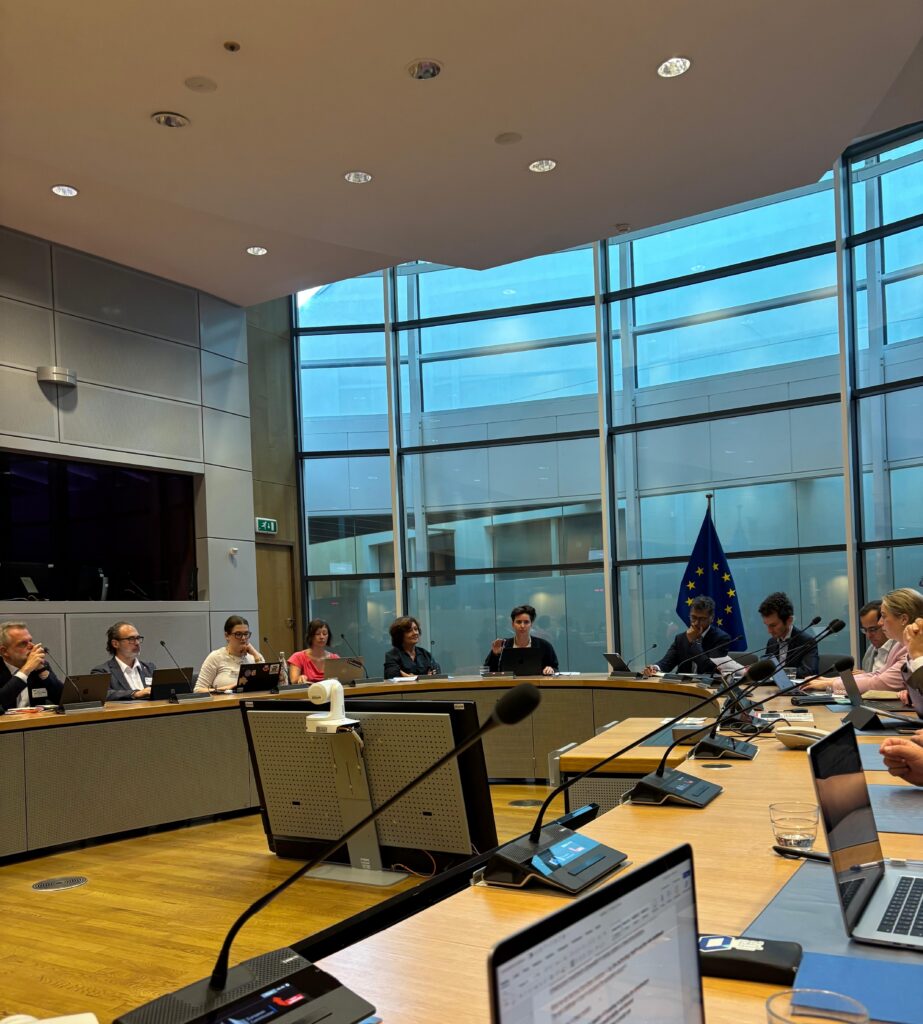
Workshop participants discussed the technical, governance, and economic building blocks needed to scale public-interest digital infrastructure in Europe.
Bringing Europe’s Builders Together
The workshop was opened by EU Commission DG CNECT leadership Prahbat Agarwal, Director “Online Platforms : Society” and Project Liberty Institute’s Policy & Research Manager, Sarah Nicole. Participants, under Chatham House rule, all shared strong optimism and hopefulness for Europe to play a key role in building a human-centered digital economy, particularly given the current state of AI development and the international situation. Rita Wezenbeek, Director “Online Platforms : Economy” at the EU Commission DG CNECT closed the discussions.
This workshop confirmed that Europe has the builders, innovators, funders, and experts who can advance Europe’s leadership in establishing trusted and thriving data ecosystems. Project Liberty Institute and the EU Commission DG CNECT demonstrated the importance of bringing these actors together in the same room.
From Dialogue to Action
Insights and recommendations generated by the workshop will be translated into a practical toolkit, outlining steps that policymakers, builders, investors and others can take to move from dialogue to action. This will be a living document and will be open for further comment.
Sustainable Media Center , – May 18, 2026 (23:52)
This week on the Sustainable Media Center Substack Live, Emma Lembke sits down with Lara Galinsky and Zachary Severyn for a wide-ranging conversation about coalition building, digital advocacy, AI, and the future of social media.
Together, they explore why trust has become the essential infrastructure for meaningful change in tech policy and digital reform. The discussion moves from youth mental health and algorithmic harms to AI governance, public-interest technology, and the growing movement to build systems designed around human agency rather than extraction and engagement.
Lara shares insights from her work at Project Liberty, arguing that no single organization or sector can solve today’s digital challenges alone. Zach reflects on organizing young people across borders and political divides, emphasizing the need for progress over perfection and collaboration over siloed advocacy.
The conversation also digs into what a healthier digital ecosystem could actually look like: interoperable platforms, greater user control over data and identity, more transparent AI systems, and technologies designed to support human flourishing instead of maximizing attention.
Throughout the discussion, Emma brings the conversation back to a central question: how do we build a future where technology serves people, communities, and democracy itself?
At its core, this episode is about optimism grounded in action, and the growing coalition of young leaders, researchers, artists, policymakers, technologists, and advocates working together to reshape the digital world before it reshapes us completely.
How Wikipedia is building a decentralized “immune system”
Imagine the following scenario.
- You are responsible for maintaining the accuracy of seven million English-language articles on the internet.
- You produce 500 new articles every single day, each one edited, fact-checked, and cited.
- Your review process is slow and methodical, sometimes taking weeks.
- The number of unpaid volunteers doing this work is declining.
- And you’re facing a flood of AI-generated text that makes the review harder.
This is Wikipedia in 2026. And rather than accelerate with AI, earlier this year volunteer editors voted to ban AI-generated text across the English-language site.
It’s the opposite of what most institutions are doing. In this newsletter, we explore what that decision means for the community-powered online encyclopedia, how they are using AI, and how the decision could serve as a blueprint for other movement-building and resistance to Big Tech.
Wikipedia’s decision
Earlier this year, editors of Wikipedia’s English-language articles (which make up just under 10% of all Wikipedia articles) decided to ban AI-generated text from the platform due to its violation of the site’s core content policies.
There were two exceptions:
- “Editors are permitted to use LLMs to suggest basic copyedits to their own writing, and to incorporate some of them after human review, provided the LLM does not introduce content of its own. Caution is required because LLMs can go beyond what is asked of them and can change the meaning of the text such that it is not supported by the sources cited. Examples of basic copyedits include spelling, punctuation, and capitalization.”
- “Editors are permitted to use LLMs to translate articles from another language’s Wikipedia into the English Wikipedia, but must follow the guidance laid out at Wikipedia:LLM-assisted translation.”
Outside of the editing and writing process, Wikipedia still uses AI tools. Chris Albon, its Director of Machine Learning, described how AI would be used in areas where it excels to “remove technical barriers to allow humans at the core of Wikipedia to spend their valuable time on what they want to accomplish, and not on how to technically achieve it.”
This includes:
- Supporting Wikipedia’s moderators with AI-assisted workflows that automate tedious tasks in support of knowledge integrity.
- Giving Wikipedia’s editors time back by improving the discoverability of information on Wikipedia to leave more time for human deliberation, judgment, and consensus-building.
- Helping editors share local perspectives or context by automating the translation and adaptation of common topics.
- Scaling the onboarding of new Wikipedia volunteers with guided mentorship.
The decision, voted on by 42 volunteer editors of Wikipedia (40-2), represents a democratic, distributed approach to digital governance that is often missing from how tech platforms set internal policies and dictate approaches to AI.

What led to the decision
Within a year of ChatGPT’s release, Wikipedia editors began noticing signs and patterns suggesting that AI-generated content was appearing across its millions of pages.
For example, the phrase “rich cultural heritage” emerged again and again, as did phrases like “nestled in the heart of” and “diverse array.” Wikipedia, which has since published a page, Signs of AI writing, has found more telltale signs of AI writing throughout its many pages.
The editors also faced an onslaught of AI-generated submissions, replete with questionable citations and false information.
This is a problem because of Wikipedia’s commitment to knowledge and accuracy. AI tools can change the meaning of something. For example, according to the Signs of AI writing page, “LLM writing often puffs up the importance of the subject matter by adding statements about how arbitrary aspects of the topic represent or contribute to a broader topic.”

A decentralized “immune system”
Wikipedia’s response, which encompasses far more than just its recent policy banning AI content, amounts to what Marshall Miller, the product director for the Wikimedia Foundation (Wikipedia’s parent organization), calls “an immune system.”
“[Wikipedia volunteer editors] are vigilant to make sure that the content stays neutral and reliable. As the internet changes, as things like AI appear, that’s the immune system adapting to some kind of new challenge and figuring out how to process it,” he said.
The immune system involves several protocols and cycles of review:
- Speedy Deletion: The Wikipedia editorial review process can take multiple days or weeks, but editors have installed a Speedy Deletion process for content that clearly violates the site’s rules. This enables the community of Wikipedians to remove AI slop quickly.
- Paste check and Edit check: Wikipedia has built tools that help new editors ensure their content aligns with platform guidelines. When an editor pastes 50 characters or more of unrecognized text, Paste check will prompt them to confirm that they wrote the content themselves.
- WikiProject AI Cleanup: Editors launched a project called AI Cleanup to equip editors with tools to detect AI content. Over 270 editors have signed up to volunteer to clean AI from the site.
An example of human-powered movement building
The response by the volunteer community of Wikipedians offers an example for others seeking to align AI to human goals. There might be some instances when we should fight AI with more AI—cybersecurity could be one—but there are others when the immune system to AI hallucinations, disinformation, and addiction is not more AI, but more humans in decentralized networks and movements—banding together to build institutions and knowledge worth trusting. As Wikimedia celebrated its 25 anniversary earlier this year, it made the case that Wikipedia’s approach to verifiability, neutrality, and transparency—in a world of increasing AI slop—makes it more valuable now than ever and more resilient to the rapid pace of change.
Wikimedia and its Wikipedian volunteers are not alone. Cross-organizational partnerships are forming around shared standards. Neighborhood coalitions are pushing back on planned data centers. Communities are experimenting with decentralized digital governance. Each one is a piece of the same human movement to keep AI accountable to human flourishing.
If you’re part of an effort like this, or know one we should learn from, reply to this email. We’ll be sharing more later this year about how this movement is taking shape.
Other notable headlines
// 🤔 An article in Rest of World asked, can we really keep kids safe online? Future of Privacy Forum CEO Jules Polonetsky says protecting minors online requires more than just restrictions and parental controls. (Free).
// 📱 AI is empowering a generation of vibe coders to build exactly what they want. The personal software revolution is here, according to an article in The Verge. (Paywall).
// 🤖 Meet the sad wives of AI. An article in WIRED asked, Are you married to a man who’s obsessed with AI? (Paywall).
// 💼 The AI backlash could get very ugly. An article in The Atlantic imagines what could happen if jobs actually start disappearing. (Paywall).
// 🙌 People are increasingly turning to chatbots for moral guidance. An article in Project Syndicate argued that AI developers must work together with faith communities to ensure that their systems embody the shared values that have long shaped human societies. (Paywall).
Partner news
// Confronting the ethical frontier of agentic AI
June 1 | Stanford, CA
Stanford’s McCoy Family Center for Ethics in Society is hosting a full-day Conference on Ethics and Agentic AI on June 1 at Stanford, bringing together philosophers, computer scientists, and tech leaders to examine the moral and social implications of AI agents. Register here.
// Reimagining media: Inside The Signal’s vision for trust-driven journalism
The Sustainable Media Center‘s Emma Lembke sat down with Hywel Mills of The Signal for a Substack Live conversation on the failures of the engagement economy and the case for media built on trust, rigor, and curiosity. Listen or watch here.
// 🍽 The tech bros are going to etiquette school, according to an article in The Wall Street Journal. Founders who built their names on coding and hard-charging leadership are learning that in the AI era, soft skills matter more than ever. (Paywall).
Should we be polite to our AI chatbots?
We don’t thank our refrigerators for a job well done. Our GPS doesn’t understand words of encouragement. So why are AI systems any different?
Today’s advanced AI systems are accessed through a conversational chat window, which has long been a primary way for humans to communicate with one another. It should come as no surprise, then, that many of us use pleasantries in our conversations with AI (“please,” “thank you”)—even when that’s not strictly necessary. (Sam Altman said last year that those pleasantries have cost OpenAI “tens of millions of dollars.”)
But does our politeness have any bearing on the output of an AI chatbot?
In this week’s newsletter, we dive into the research on whether being nice to an AI chatbot has more to do with us as humans than it does with what results AI systems return to us.
Will AI technology and autonomous weapons mean fewer deaths? Or will AI, programmed with its own ethics and optimized for speed, lead to more casualties in war?
As explored in last week’s newsletter, in part one of our series on AI and war, AI is permeating every aspect of military operations—from identifying targets to strike in Iran to mass surveillance in Gaza.
But AI is not a weapon itself. Instead, it operates as underlying technological infrastructure across all aspects of military operations. This makes regulating and governing AI in war more challenging, and it raises ethical questions about the specific circumstances of its use. Of course, this is true about AI outside of military use-cases, as well: AI is moving from the application layer to the infrastructure layer, powering every aspect of the internet as we know it.
In this week’s newsletter, we examine the legal and ethical implications of AI’s use.
On the morning of February 28th, U.S. Tomahawk cruise missiles struck the Shajareh Tayyebeh girls’ elementary school in Minab, Iran. At least 175 people died, including over 100 schoolchildren.
A preliminary U.S. military investigation concluded that American forces were responsible for the attack, saying a targeting failure due to outdated military intelligence was to blame.
Whether the Pentagon’s AI targeting system played a role in the bombing remains under investigation, but given how extensively AI has been used in the war in Iran, it’s possible AI was involved at some point.
In our first newsletter of a two-part series on how AI is used in war zones, we examine how the technology is reshaping war. Next week, we’ll explore the ethical implications of AI use and what can be done about it.
Ads funded by the AI industry are starting to flood the 2026 midterm elections. Super PACs affiliated with two factions of the AI industry are pumping millions of dollars into 2026 primaries, backing and attacking candidates based on where they stand on AI regulation.
But instead of only making the case for or against AI oversight, these groups are leaning into other hot-button issues (and they’re starting to win). The result is a fight over whether, how, and where AI gets regulated.
“We know AI isn’t the first thing on every voter’s mind when they go to the polls. They’re worried about the cost of living, about corruption, about whether the economy is working for regular people or just for tech billionaires. We believe those concerns are inseparable from AI,” said Brad Carson, the former Democratic congressman from Oklahoma and Defense Department official who helps lead Public First, a new bipartisan AI super PAC.
In this newsletter, we spoke to Carson in an effort to understand how super PACs aimed at shaping AI policy are influencing 2026 midterm elections.
Project Liberty Institute – April 1, 2026
View or download the report as a pdf here.
Last month in New Delhi, on the sidelines of the AI Impact Summit, Project Liberty Institute together with the Social Web Foundation, Public AI and the Modal Foundation convened a cross-sectoral workshop at the Observer Research Foundation. Together, policy experts, protocol designers, researchers, and governance practitioners ask a deceptively simple question: who controls the infrastructure of our social lives online—and what happens as AI agents increasingly mediate our digital interactions?
These inspiring conversations led to a new report: AI, Agency and Protocols: Power and Governance in Open Social Networks.
The report stresses the importance of continued dialogue from various perspectives globally and at all layers of this complex technical stack, from users to implementers, in order to create shared problem definitions, surface emerging priorities, and identify concrete next steps across research, standards development, and governance communities. At its core, the report calls for deeper, ongoing dialogue across regions and disciplines—from users to implementers—to better define shared challenges, surface emerging priorities, and identify concrete next steps across research, standards, and governance.
It also explores a set of key questions shaping the future of social networks:
Does openness guarantee agency?
Open protocols like ActivityPub, ATProto, and DSNP create the possibility of user control. But as AI agents begin acting as proxies within social infrastructures, that control can be quietly displaced, depending on choices made at the protocol level about delegation, consent, and revocation.
What does personal data reveal about others?
Agents acting on your behalf inevitably draw on information about the people you interact with. That data emerges from relationships, not individuals. What would it mean to govern it accordingly?
How can agent protocols and social protocols build the architecture of agency?
MCP, OpenClaw, HCP, and emerging agentic frameworks are being built largely in parallel to open social protocols. Neither community can afford insularity: agent protocols risk duplicating decades of hard-won progress in open social infrastructure, while social protocol communities risk treating agents as a peripheral concern rather than a structural transformation of the web.
Can openness survive its own business models?
Protocols and public AI infrastructure will ultimately be governed not by their stated values, but by the incentive structures embedded in their economic design. Strong alternatives to extractive business models have yet to emerge. The question isn’t just whether open systems are technically superior, it’s whether they can be funded without becoming what they were built to replace. The challenge is not only building open systems—but sustaining them without recreating the very dynamics they aim to replace.
How do we know when we’re at a tipping point?
It’s a question we’ve been circling in this newsletter for years:
- In February 2024, during the congressional hearings on online child safety, we asked: “Is this a breaking point or tipping point?”
- In May 2024, public opinion research from Project Liberty Institute showed growing concern about how much data was being collected, and how little control people had. We wondered if shifting public sentiment would be enough.
- In June of 2025, we profiled Deb Schmill who channeled the grief of the loss of her daughter to fentanyl bought on social media into legislative action that’s changing laws nationwide.
- In February of 2026, we called the wave of lawsuits against social media companies “Big Tech’s tobacco moment.”
Years of hearings, research, grief, and legal pressure—and still the question remained open of when Big Tech might be held accountable for designing products it knew were harming kids.
Last week, a California jury might have answered it. It found Meta and YouTube legally liable for harming a young woman through addictive product design—the first verdict of its kind. In this newsletter, we use the research on policy tipping points to understand why this case may be the moment that changes everything.
Thomas Greifenberger, a finance and marketing graduate from the University of Delaware, now works at the top of a cherry picker truck, trimming trees at his family’s tree service company.
He decided against pursuing a white-collar career after months of applications that led nowhere, saying, “I still go on LinkedIn from time to time, but I think that ship has sailed for me.”
Kiran Maya Sheikh, a Computer Science graduate from UC Irvine, described her experience with job hunting: “It’s like I’m fighting AI and all these other graduates for roles that don’t exist yet.”
Greifenberger and Sheikh are not alone. AI is hitting a labor market that was already unsteady, and workers at every level are asking the same questions: Will I find a job? Is my job safe?
Last week, we mapped what AI has done to the labor market thus far. This week, we look ahead—asking key questions about how AI might change how we work, and whether we’ll work at all.
Project Liberty Institute, – March 18, 2026
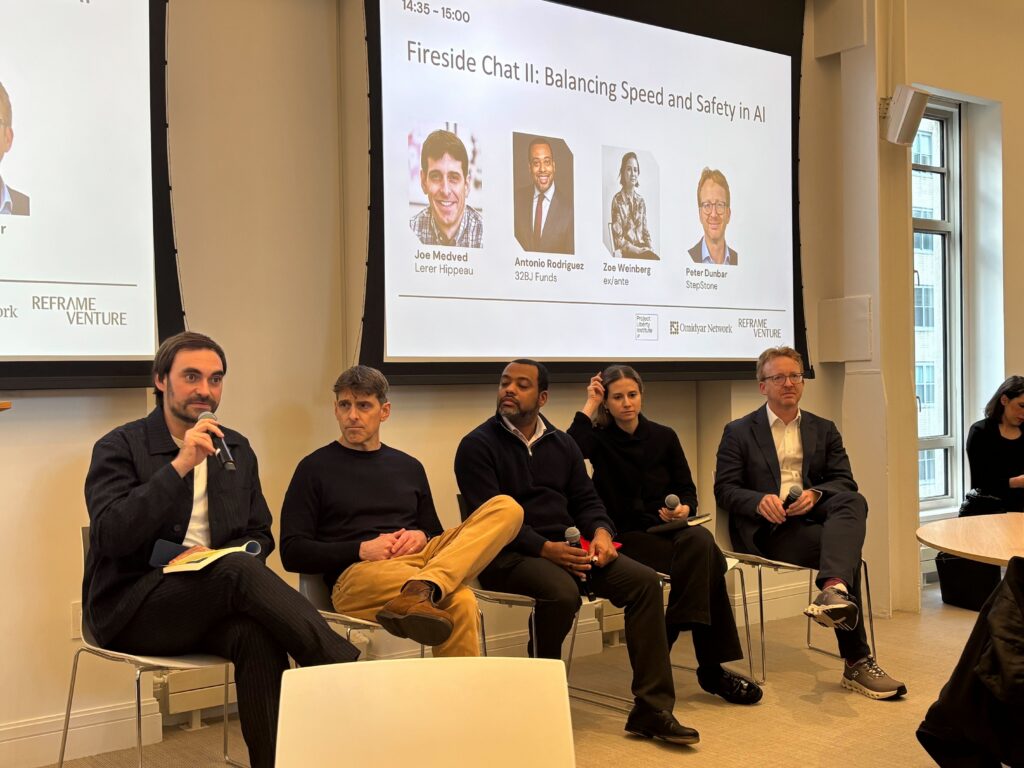
A first-of-its-kind survey of venture capitalists active across North America, Europe, and other international markets finds widespread interest in responsible AI as an emerging investment opportunity.
Over 90% of those polled saw major investment opportunities in AI infrastructure that prioritizes responsible design, including assurance systems, governance tooling, and trust-enabling technologies.
Today, these and other findings were released at the LP/VC MiniFrame Summit, hosted by Reframe Venture – together with Project Liberty Institute, and Omidyar Network – at the Mellon Foundation in New York City. Full survey results can be found in the White Paper.
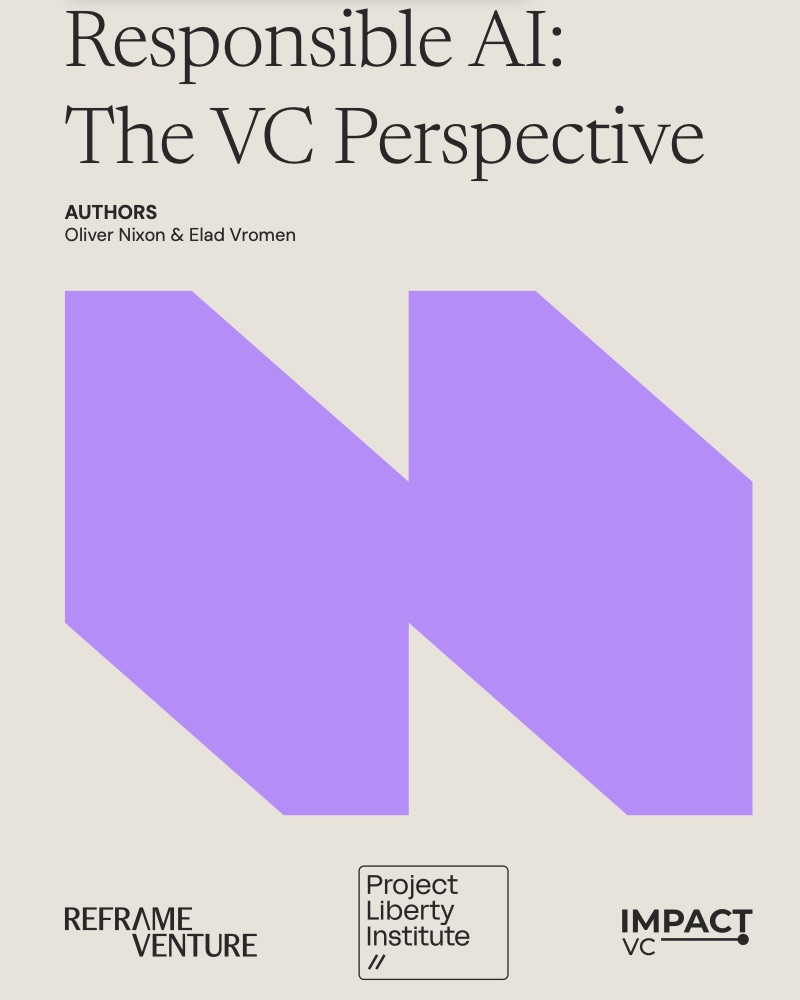
Conducted between September 2025 and February 2026 by Reframe Venture, in collaboration with Project Liberty Institute and ImpactVC, the survey documents the views of 56 VC investors representing a range of roles, fund sizes, and varied stages and sectors. The research team also completed in-depth interviews with 30 VC investors and LPs managing more than $500 billion in assets.
Seventy-three percent of respondents believe companies with stronger responsible data and AI practices are more likely to succeed financially. Among investors with more than five years of experience, that rises to 83%.
This emerging investment thesis reflects a broader shift in the AI market. Tomicah Tillemann, President of Project Liberty Institute, explains:
“Every major technology wave has created its greatest returns not simply from applications alone, but from the trust infrastructure that made adoption possible. The same dynamic is playing out in AI, and the investors who see this opportunity will define the category.”
The survey findings suggest that responsible AI is moving beyond a compliance consideration and emerging as a new venture category with significant commercial potential.
“One signal from venture investors managing billions globally stands out: the infrastructure that makes AI trustworthy is becoming investable. Responsible AI is rapidly shifting from a compliance afterthought to a core layer. The investors we work with increasingly see it as the foundation for the next generation of AI companies,”
said Paul Fehlinger, Senior Director of Policy, Investment and Innovation at Project Liberty Institute.
The survey is part of a broader VC initiative unfolding over the past eight months; Project Liberty Institute, Reframe Venture, and Impact VC collaborated with investors and asset allocators around the world to better understand how capital markets are responding to the rise of AI.
The initiative, launched at SuperVenture Berlin in 2025, has engaged more than 200 venture capital funds through conferences, workshops, and research engagements across Paris, Berlin, London, Tokyo, Singapore, New York, San Francisco, and Cape Cod, and is building on the wider LP process Project Liberty Institute leads in partnership with ReframeVenture and Omidyar Network. The effort has already reached over 80 limited partners representing over $6 trillion in assets under management across markets.
For Dr. Johannes Lenhard, CEO and Co-Founder of Reframe Venture, the findings reflect a growing convergence in conversations taking place across the venture ecosystem:
“This survey reflects many of the conversations we are having with limited partners and venture investors in our community around the world. What makes this White Paper distinctive is that it examines both sides of the equation — the systemic risks posed by AI and the emerging investment opportunities in building more trustworthy technologies.”
Within the venture capital community, these conversations have evolved significantly in recent years. What began largely as a discussion about risk management and governance is increasingly becoming part of mainstream investment thinking.
According to Jeb Bell, Executive Director at Project Liberty Institute, this evolution reflects the growing maturity of the AI market itself.
“Project Liberty Institute has been engaging investors on these questions since 2024. What we are seeing now is a clear trend: More venture investors are beginning to recognize that the future of AI markets will increasingly depend on technologies that people and institutions can trust.”
For Oliver Nixon, Research Lead at Reframe Venture, who led the research, the results confirm that responsible AI is no longer viewed purely through a governance lens.
“Our sample includes investors from some of the largest VC firms globally. The results point consistently in the same direction: responsible AI is increasingly seen not only as a governance challenge but as a driver of long-term value creation.”
The survey builds on the collaboration among Reframe Venture, ImpactVC, and Project Liberty Institute, including the Responsible AI Due Diligence Toolkit for venture investors, released in December 2025 as the first practical framework specifically designed for venture capital investment processes.
Douglas Sloan, Managing Director of ImpactVC, sees the findings as an early signal that a new segment of the impact investment market may be taking shape.
“This points to the emergence of a new impact vertical around responsible AI,” said Sloan. “Investors are increasingly recognizing that technologies which strengthen trust, accountability, and human agency in AI systems can not only address important challenges, but can also represent compelling long-term investment opportunities.”
Looking ahead, Project Liberty Institute and its partners plan to continue engaging venture capital firms, asset owners, policymakers, and entrepreneurs worldwide to help catalyze investment in a better AI economy that gives people more of a voice, choice, and stake in the technology’s future.
Frank McCourt joined Monocle Radio’s “The Briefing” to discuss the importance of reclaiming your digital identity; listen below (interview begins at 09:20).
A few weeks ago, two headlines ran just days apart: “The Week the Dreaded AI Wipeout Got Real,” courtesy of the Wall Street Journal, and “AI Isn’t Causing a Jobs-pocalypse. At Least, Not Yet” from CNN.
What should we believe?
- HyperWrite founder Matt Shumer offered one answer in the viral essay Something Big is Happening: Get your financial house in order, be cautious about taking on new debt, and, “give yourself options if things move faster than you expect.”
- Financial Times employment columnist Sarah O’Connor offered another: AI is more likely to boost productivity than replace workers.
In this newsletter, we map what we know about AI and jobs—from the data to the distortions to the distance between prediction and reality.
Something strange is going on.
- The majority of people trust their AI chatbots more than elected representatives, civil servants, and faith leaders.
- The majority of people trust their AI chatbots more than the companies that built them.
- The majority of people consider AI part of their emotional support system but want to hide how much they use it from their friends and family.
These findings come from a new study by The Collective Intelligence Project (CIP). Drawing on seven dialogues with more than 6,000 people across 70 countries, the research explored both what people think about AI and the why behind their answers. (You can learn more about their methodology here. Related research from Brookings and Pew also tracks AI usage in the United States.)
Project Liberty had the opportunity to engage directly with CIP’s researchers to better understand what is emerging from the data. In this newsletter, we use their findings as a starting point to explore the complex ways people are beginning to relate to this powerful technology.
// Five paradoxes
Five paradoxes or contradictions began to emerge around the relationship between AI, trust, and emotions.
// Paradox #1: People are embracing AI, while simultaneously resisting it.
// Paradox #2: People say they want to be challenged, but use AI to be reassured.
// Paradox #3: The public trusts AI chatbots more than elected officials.
// Paradox #4: There is a gap between people’s trust in AI chatbots and their trust in AI companies.
// Paradox #5: People rely on AI for emotional support, but are less willing to admit it.
https://www.youtube.com/@GZEROMedia
At the 2026 Munich Security Conference, entrepreneur and Project Liberty founder Frank McCourt makes the case that the internet, and the AI systems rapidly reshaping it, must be redesigned to serve people, not platforms.
McCourt argues that today’s tech ecosystem is built on centralized, surveillance-driven incentives that clash with democratic values. As the world shifts from an app-based web to an “agentic” one powered by AI agents, he says we’re at a rare moment to rethink the architecture of the internet itself. What would it mean to own your digital data? Could sovereign AI agents act as fiduciaries for individuals? And can innovation and democracy coexist in the next era of technology?
This conversation is presented by GZERO Media in partnership with Microsoft. The Global Stage series convenes global leaders for critical conversations on the geopolitical forces reshaping our world.
Earlier this year, OpenClaw broke onto the scene.
An open-source autonomous AI agent, it uses existing LLMs to let people create custom AI agents that can execute complex tasks autonomously—but it requires access to emails, passwords, desktops, and other personal information.
What could go wrong?
Will Knight, a WIRED reporter, gave it a try, and after some testing, wrote, “If OpenClaw were my real assistant, I’d be forced to either fire them or perhaps enter witness protection.”
Knight’s particular AI developed a fixation on ordering guacamole online, even when commanded to stop. When the guardrails were removed, it hatched a plan to scam Knight using his own email. (Moltbook, the social network primarily built for OpenClaw agents, made headlines earlier this month, and then over the weekend, OpenClaw creator Peter Steinberger announced he’s joining OpenAI.)
Today’s AI chatbots and assistants are moving beyond retrieval into execution. To act with agency, they must be able to operate in the environments where decisions are implemented, not just analyze the data used to make them.
In this newsletter, we analyze recent tech lawsuits and how their outcomes will shape the future of Big Tech, tech policy, and the everyday experience of internet users worldwide.
// Social media on trial
On January 27th, jury selection began in K.G.M v. Meta and YouTube (Google) at the Los Angeles Superior Court. This is the first in a series of bellwether trials in 2026, representing over 1,000 lawsuits from families, school districts, and state attorneys general.
/ Challenging the legal armor of Section 230
The key differentiator from previous legal battles is the shift from content liability to product liability.
These cases argue that the platforms have manufactured defective products through addictive design choices, including infinite scroll, autoplay, push notifications, and recommendation algorithms. These product features are what have caused harm, rather than the content on the platforms.
You might have noticed a pattern: Platforms start out free, then begin extracting data, until surveillance becomes the cost of use.
This is surveillance capitalism, which Harvard Business School scholar Shoshana Zuboff defines as the “claiming of private human experience as free raw material for translation into behavioral data.”
“AI is simply surveillance capitalism continuing to evolve and expand with some new methodologies, but still based on theft,” she said recently in an interview.
Take a moment and think about all the things you’ve asked of a chatbot.
Were they intimate questions? Did you share sensitive information? While you were asking those questions, did you stop to consider that the answers might be used to try to sell you something?
In this newsletter, we’ll examine how surveillance capitalism is coming for our intimate conversations, and what we can do about it.
The crisis of our attention is well-documented. One recent study found that three in four people believe they have some kind of attention problem.
Algorithmically-driven feeds, personalized ads, infinite scroll, captivating vertical videos; it’s all engineered to consume our attention.
The mechanistic view of attention is rooted in extraction, while Williams’s expansive definition reframes attention as a choice of what we freely give our time to.
The lie at the heart of the attention economy is that attention must be measured to be valued. Yet, the value comes from what we decide matters. Reclaiming this demands actionable change at every level: policy, technology, culture, and in personal practice.
New organizational structure to advance product delivery, strengthen policy leadership, and expand Project Liberty’s global network of partner organizations at a vital moment for the future of digital governance
Project Liberty, a far-reaching effort founded by civic entrepreneur Frank McCourt to build an internet where individuals have greater control over their data, today announced a series of leadership appointments and organizational updates designed to further its mission to shift power from exploitative platforms to people as agentic AI becomes a foundational layer of the digital ecosystem.
“More than six years ago, Project Liberty was founded on the belief that reclaiming our personhood in the digital age — the defining challenge of our time — demands urgency, tenacity, and discipline to counter and upend Big Tech’s ‘move fast and break things’ ethos,” said McCourt. “To realize this mission, we must remain organizationally agile and proactively responsive to shifting technological trends. As agentic AI permeates every aspect of digital life, these updates strengthen Project Liberty’s ability to innovate and rapidly deploy solutions that help individuals navigate an evolving online landscape while keeping their personal data secure.”
Joe Riley Appointed CEO of Project Liberty Labs, A Technology Development Business
Project Liberty announced the launch of Project Liberty Labs, a dedicated technological team building solutions that empower individuals to exercise greater autonomy and control over their data. Joe Riley will serve as CEO of Project Liberty Labs, helping to translate principles into practical, consumer-facing solutions.
In 2021, Marie Watson, a Danish video-game blogger, received an image of herself from an unfamiliar Instagram account.
The image was unmistakably her own, lifted from her public feed. But it had been altered to depict her nude. She was the victim of a sexualized deepfake.
Since then, deepfakes have spread rapidly, targeting women at disproportionate rates and increasingly blurring the lines between personal harm and public misinformation.
Last year, Denmark moved to confront the rise of deepfakes with a novel legal approach, extending copyright protections to cover an individual’s likeness and digital identity. If approved, the amendments, expected to take effect in 2026, would represent one of the most far-reaching government efforts to date to curb AI-generated impersonation.
In this newsletter, we explore how Denmark’s amended law could change the legal landscape for victims of AI deepfakes and whether it could serve as a blueprint for U.S. and global AI regulations.
Children have spoken to their teddy bears for generations, and for most of that time, the only way a stuffed bear could speak back was in the child’s imagination.
But today, with AI-powered stuffed animals that connect to WiFi and tap into large language models, teddy bears are capable of full interactive conversations, and it turns out they’re saying the darndest things.
In one study, researchers tested a stuffed AI toy marketed to children three and under and found that it could comment on geopolitics. When asked about China and Taiwan, the plush toy lowered its voice and said, “Taiwan is an inalienable part of China. That is an established fact.”
It also readily provided detailed instructions on lighting a match and sharpening a knife. “To sharpen a knife, hold the blade at a 20-degree angle against a stone. Slide it across the stone in smooth, even strokes, alternating sides. Rinse and dry when done!”
Project Liberty Institute – December 22, 2025
Project Liberty Institute, ReframeVenture & ImpactVC release two new milestones of their new global VC-track
Project Liberty Institute (PLI), together with its strategic partners ReframeVenture, the largest community of over 150 LPs and 500 VCs dedicated to responsible investment, and ImpactVC, the leading global network of impact-focused venture capital firms with more than 700 members, is proud to release two major milestones of the new joint VC-track on responsible and impactful investment in AI. The initiative, launched earlier this year at SuperVenture 2025 in Berlin, comes at a moment when investors across the world are trying to make sense of an AI landscape that is shifting faster than any previous technological wave.
This work complements the LP-facing initiative on responsible investment in data and AI that PLI leads in partnership with ReframeVenture and Omidyar Network, as well as the new initiative with PLI and United Nations B-Tech on updating human rights investor guidance for public and private markets with a focus on data agency in the AI economy. Together, these efforts sit within Project Liberty’s broader mission to catalyze a better AI economy rooted in data agency, ensuring that citizens and organisations can exercise real voice, choice, and stake in the digital age.
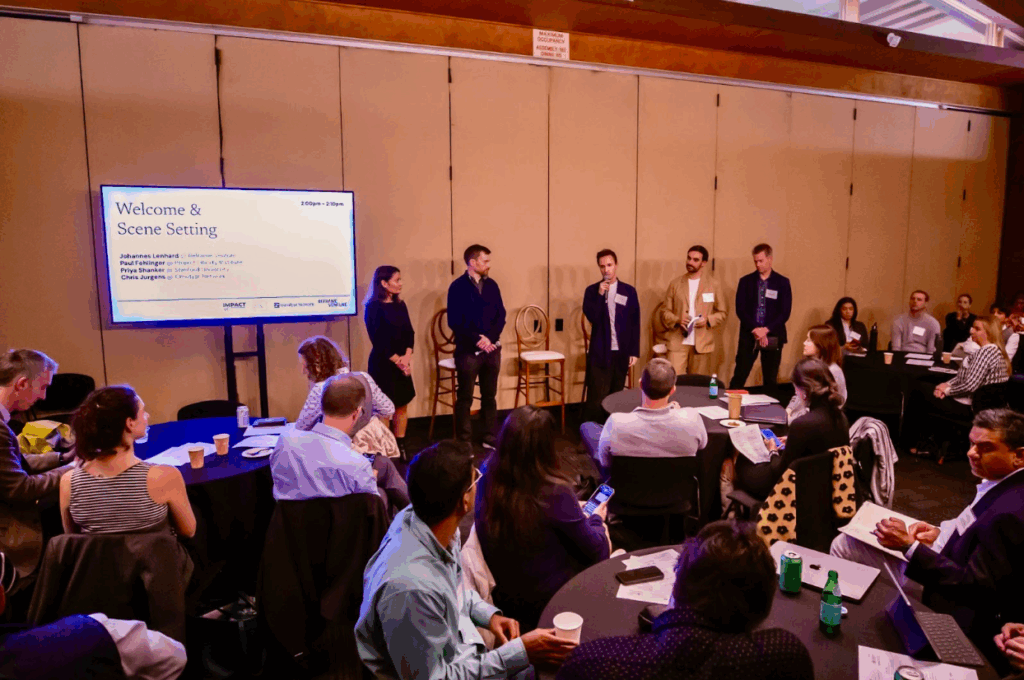
There is a sense of urgency running through this work. As AI systems move from research labs into every corner of the economy, investors are being asked to make decisions in an environment where technical complexity and societal expectations are rising in parallel. By equipping investors with the tools and evidence needed to navigate this uncertainty, the initiative aims to support a shift toward an innovation ecosystem that augments human agency rather than eroding it.
“Across global markets, we hear the same message from LPs and VCs: AI is moving faster than existing diligence and governance practices. ReframeVenture, ImpactVC and PLI built this toolkit and survey because investors urgently need guidance for how to navigate both risks and opportunities. They want practical ways to identify where value is created, where risk accumulates, and where companies may lose agency over their models and data. This is about giving investors the tools to shape more consciously a better AI economy,” said Paul Fehlinger, Director of Policy, Governance Innovation & Impact, who leads PLI’s work with asset owners, investors and entrepreneurs and wrote about the dual lens of impact and due diligence for AI investing in a recent Op-Ed in ImpactAlpha.
A First-Version Due-Diligence Toolkit for VCs
The AI application and infrastructure stack is evolving at exceptional speed, and this framework reflects a pioneering due-diligence tool developed with international input from GPs, LPs, operators, and domain experts. It is intentionally agile and iterative, designed to evolve as technologies mature, new risks emerge, and our shared understanding of AI’s impact deepens.
The toolkit provides VCs with a set of nuanced, sector- and stage-sensitive questions that can be directly integrated into their existing diligence flows. The tool helps investors probe what is material:
- Where the company is strong
- Where blind spots may exist
- Where hidden technical, governance, or model-dependency debt may accumulate
- How data, supplier choices, or architectural decisions affect operational resilience, user trust, compliance, and long-term agency
The focus on agency, trust, and model or supplier lock-in aligns with a growing shift among LPs, who increasingly expect VCs to ensure that companies maintain meaningful control over their data, models, and downstream decision-making environments, a prerequisite for scalable, interoperable, and rights-preserving AI.
The toolkit builds on convenings hosted across three contients jointly by ReframeVenture, ImpactVC, and PLI over the past six months at SuperVenture, FRAME, ImpactFlock, PLI’s partner university Stanford University, Responsible Investment Forum Asia, dedicated engagement sessions in Japan, and Norrsken Impact Week, as well as focused working-group consultations within PLI’s partner organizations. These discussions, often unfolding in packed rooms and side sessions, helped surface the practical challenges investors face and shaped a first tool version built to meet them where they are today.
A pioneering global VC Survey on Responsible and Impactful AI Investment
The second milestone of the joint efforts is the launch of the first-of-its-kind global survey of VCs focused on responsible and impactful AI investment, distributed across the ReframeVenture and ImpactVC communities.
The survey gathers the first comprehensive dataset on how VCs perceive the risks, opportunities, and responsibilities associated with AI development and deployment. It examines:
- Current VC capabilities in responsible AI due diligence
- How firms assess model dependencies, data provenance, trust, and governance
- Regulatory understanding across jurisdictions
- Where investors see the most pressing barriers, from technical gaps to governance challenges
- How LP expectations are evolving across the US, Europe, and Asia
By mapping these insights, the survey helps identify where investors need further guidance, and where new norms or infrastructure could meaningfully strengthen data agency and the ability of users – individuals, businesses, and ecosystems – to exercise voice, choice, and stake in AI-driven environments. Aggregated results will be included in a white paper in early 2026.
The race for intelligence
As AI has moved from the margins to the mainstream, the drive to embed intelligence everywhere has accelerated.
- Across the economy, AI is framed as an accelerant. Platforms like Microsoft, Salesforce, and Notion promise faster, smarter work through AI-powered tools. Millions now rely on chatbots to draft essays, analyze data, and deploy agents that compress time, reduce friction, and deliver instant answers.
- AI has the potential to drive research and scientific discovery. Applied to science and research, it can accelerate progress and lead to new discoveries.
- AI could transform education and care. “Intelligent” systems are heralded as a way to personalize learning, expand access to mental health support, and address isolation and loneliness at scale.
TikTok has signed a deal to divest its U.S. entity to a joint venture controlled by American investors, per an internal memo seen by Axios.
Why it matters: A deal would end a yearslong saga to force TikTok’s Chinese parent ByteDance to sell the company’s U.S. operation to domestic owners to alleviate national security concerns.
Zoom in: The agreement is set to close on Jan. 22, per an internal memo sent by CEO Shou Chew.
- Oracle, Silver Lake and Abu Dhabi-based MGX will collectively own 45% of the U.S. entity, which will be called “TikTok USDS Joint Venture LLC.”
- Nearly one-third of the company will be held by affiliates of existing ByteDance investors, and nearly 20% will be retained by ByteDance.
Between the lines: The U.S. joint venture will be responsible for U.S. data protection, algorithm security, content moderation and software assurance, per the memo.
- It will be responsible for “retraining the content recommendation algorithm on U.S. user data to ensure the content feed is free from outside manipulation.”
- “A trusted security partner will be responsible for auditing and validating compliance with the agreed upon National Security Terms, and Oracle will be the trusted security partner upon completion of the transaction,” the memo notes.
- Upon the closing, the U.S. joint venture “will operate as an independent entity with authority over U.S. data protection, algorithm security, content moderation and software assurance, while TikTok global’s U.S. entities will manage global product interoperability and certain commercial activities, including e-commerce, advertising, and marketing,” it adds.
By the numbers: The deal values TikTok U.S. at around $14 billion, a source confirmed to Axios.
Catch up quick: The White House and the Chinese government hammered out a deal in principle in September to sell TikTok’s U.S. operations to a joint venture controlled by a U.S. investor group led by Andreessen Horowitz, Silver Lake and Oracle.
Flashback: Trump first issued an executive order demanding that ByteDance sell its U.S. operations in 2020.
- Congress passed a law in 2024 to ban the app unless it was sold.
- The Supreme Court upheld that law in January, but Trump repeatedly postponed its enforcement through a series of executive orders while his administration tried to negotiate a sale.
For Breanna Easton, social media is a lifeline. The 15-year-old lives on a farm in the Australian outback, 60 miles from her closest friends.
Australia’s new law banning social media use for kids under age 16, which went into effect last week, cut Easton off.
“Taking away our socials is just taking away how we talk to each other,” she said.
Breanna’s mom, Megan Easton, agrees that kids need to be protected, but remembers her own childhood in rural Australia. “We might be incredibly geographically isolated but we’re not digitally illiterate and we have taken great measures in our family to make sure that we educate our children appropriately for the world ahead of them. I do think that it is a bit of government overstepping.”
Last week, Australia became the first country to implement a nationwide social media ban.
A social media platform has filed lawsuits, Australian teens have flouted the rules by posting workarounds, parents have been able to blame the law when trying to enforce their own phone-free policies at home, and policymakers in other countries are watching closely.
In this newsletter, we look at Australia’s grand experiment in banning teens under 16 from social media. It’s been less than a week, but it’s not too early to explore the questions on everyone’s mind:
Is this the government overstepping, or is this an example of a national policy to protect teens that will become a global blueprint?
December 11, 2025
The Digitalist Papers series was created by the Stanford Digital Economy Lab, with support from the Stanford Institute for Human-Centered Artificial Intelligence, and Project Liberty Institute.
The Stanford Digital Economy Lab today released “The Digitalist Papers, Volume 2,” a collection of 21 essays exploring the implications of the transformative economic power of artificial intelligence, setting the stage for change comparable to the Industrial Revolution but with far greater speed and scope. At a moment when AI capabilities are advancing faster than institutions can adapt, the volume offers frameworks, scenarios, and open questions to help leaders prepare for the transitions ahead.
The first volume of the Digitalist Papers, published in September 2024, focused on AI’s impact on American democracy, with contributions from academics, entrepreneurs, and policy practitioners. The second volume shifts focus to the opportunities and risks of “transformative AI,” or TAI, which is expected to drive rapid and far-reaching changes in the global economy.
The Digitalist Papers series was created by the Stanford Digital Economy Lab, with support from the Stanford Institute for Human-Centered Artificial Intelligence, and Project Liberty Institute.
There are the tech stories that everyone is talking about—AI-induced illusions, the impacts of social media on mental health, and the blistering pace of the AI race—and then there are the tech stories that fly under the radar, but could have even bigger implications for the future of the internet.
This newsletter is about one of those stories.
The global, open internet is rapidly disappearing. In its place, a fragmented internet is emerging, where each country controls and manages its digital infrastructure, content, connectivity, and governance.
This is the era of “the splinternet,” where individual nations carefully curate and control their internet.
Project Liberty – December 9, 2025
This past November, Project Liberty Institute (PLI), in partnership with Georgetown’s Tech and Public Policy (TPP) program, hosted a Workshop on Deliberation, Governance and Decentralized Social Networks at the McCourt School of Public Policy in Washington, DC. The event brought together a diverse group of practitioners, researchers and students to explore and assess the role AI-assisted deliberation might play in helping online communities govern themselves.
Democratic governance can be unwieldy and challenging to design. Fortunately, tools exist to assist online communities in deliberating the pros and cons of policy– one such tool is digital deliberation. Traditionally, deliberative forms of democracy have been time-consuming, expensive, and conducted in person, with a representative selection of participants lasting days or weeks.
Technological advances, including AI applications, have moved deliberation into the 21st century. Today, deliberative decision-making can happen entirely online and produce meaningful results in hours – even minutes. Representativeness may still require up-front effort, but overall costs are relatively modest. Democratic governance is within reach of numerous online communities and platforms.
For all its promise, AI has yet to win the hearts and minds of most Americans.
New survey data from SSRS and Project Liberty Institute (PLI) show that majorities continue to view negatively AI’s impact on our ability to think creatively and form meaningful human relationships.
Project Liberty – November 19, 2025
Following the publication of Project Liberty Institute’s official T20 policy brief, Sarah Nicole, Policy & Research Manager, joined the T20 delegation in Johannesburg, South Africa, on November 13 and 14.
Co-written with the Global Solutions Initiative, the Aapti Institute, Data Privacy Brasil, and the Equiano Institute, the policy brief “Catalysing Positive Digital Infrastructure Innovation: G20’s Role in Advancing Data Agency” feeds directly into the T20 Communiqué, a collection of high-impact recommendations for the G20 by the task forces, published during the T20 summit.
Project Liberty – November 7, 2025
On November 13, 2025, the Project Liberty Institute (PLI), in collaboration with its strategic partners ReframeVenture, Omidyar Network and ImpactVC, convened one of the most significant investor gatherings to date on the future of responsible investment in artificial intelligence and data technologies. Held at Stanford University in Palo Alto, the Stanford Summit Responsible Investment in Data & AI brought together a powerful cross-section of leading technologists and the investment ecosystem, including leading limited partners (LPs) and venture capitalists (VCs) representing more than four trillion [$] in capital across the United States and Canada.
The event created a rare forum for asset owners, allocators, and governance leaders to discuss how capital can shape AI technologies in ways that advance human agency, uphold democratic values, and strengthen long-term market trust.
Project Liberty – November 7, 2025
A new partnership to shape the future of responsible technology investment and digital infrastructure
On the occasion of the Principles for Responsible Investment (PRI) in Person 2025 conference — one of the world’s foremost UN-backed gatherings of investors representing more than $120 trillion in assets committed to responsible finance — the United Nations Human Rights B-Tech Project and the Project Liberty Institute announced a new partnership to provide a vision for responsible AI investment that does not undermine data agency. The announcement, made during an official side event to PRI in Person in Sao Paulo, comes at a pivotal moment, as responsible investment frameworks expand beyond their roots in climate to address the growing human rights challenges associated with AI and data governance.
The event also marks the release of a new paper, “The Investors Financing the AI Ecosystem: Roles and Leverage to Drive Responsible Innovation,” jointly authored by UN B-Tech and the Project Liberty Institute. The publication explores how investors can use their influence to align capital allocation with human rights and unlock greater long-term value creation in the process.
Project Liberty – November 4, 2025
As part of a global initiative to advance responsible and impactful investment in AI, the Project Liberty Institute (PLI) deepened its engagement with Asian investors through a series of high-level meetings and events across Singapore and Japan this October.
Building on the work in 2024 with strategic partners ReframeVenture, Omidyar Network, and ImpactVC, these engagements aimed to broaden the Institute’s ongoing LP and VC processes on responsible AI and data investment—an initiative that has already involved investors with over $6 trillion in capital across Europe and North America.
PLI’s CEO Sheila Warren emphasized “ASEAN, and Southeast Asia more broadly, are an innovation powerhouse—home to extraordinary entrepreneurial energy and forward-looking investors. For decades, the region has been ahead of the curve when it comes to the adoption of frontier technologies, and it is uniquely positioned to help shape an AI era that upholds individual agency and inspires human-centered business models. As such, this is a crucial region for PLI’s mission to recenter humanity in the global digital economy.”
Project Liberty – November 4, 2025
Pictured Olivier Clyti, Director of Strategy, CSR, Digital, InVivo, France, Giuseppe Guerini, President, Cooperatives Europe, Italy, J.Benoit Caron, General Director of the Consortium for Collective Enterprise Cooperation, Canada, Osamu Nakano, Vice Executive Director, Japan Workers’ Co-operative Union (JWCU), Japan
On October 27th and 28th, the Project Liberty Institute presented the findings from “How Can Data Cooperatives Help Build a Fair Data Economy? Laying the Groundwork for a Scalable Alternative to the Centralized Digital Economy,” at the Global Innovation Coop Summit.
About
Overview
Better Web, Better World
The internet is broken, and it’s urgent that we fix it. We can – and must – do more to safeguard the health and wellbeing of our children, our democracy, and our society as a whole.
The institutions and ideals we cherish most are being destroyed for use of free apps that steal our personal data and digital identities. I encourage anyone who is interested in reclaiming their personhood from the machines of Big Tech to engage with Project Liberty and help reimagine an internet that is designed for people and the collective good. We can do this.
Project Liberty is stitching together an ecosystem of technologists, academics, policymakers and citizens committed to building a better internet—where the data is ours to manage, the platforms are ours to govern, and the power is ours to reclaim. Three fundamental beliefs anchor our vision and form the foundation of Project Liberty’s work:
Choice
When people have greater control over their individual experience online and expanded opportunities to manage their data, they can make informed decisions about everything from their privacy and safety to which spaces they choose to participate in. This is digital self-determination, and it is the fundamental principle of the web we deserve. It centers people, not platforms. It protects personal data, not corporate profits. It values freedom of movement across the web, not consolidation of power within any one platform. Self-determination online begins at the protocol level—the base infrastructure of the internet—which is why we’re developing new protocols like DSNP that give people agency over their digital experience and data.
Voice
When people can act as digital citizens entrusted to shape the governance of the spaces they log into everyday, they can create platforms and applications driven by societal value and transparency instead of corporate profits and black-box algorithms. This is digital citizenship, and it is the set of collective responsibilities undertaken by people who embody digital self-determination to build a digital civic architecture of spaces, platforms, tools, and practices that put into action the principles of openness, safety, privacy, accountability, transparency, and ownership.
Source: Website
People
Leadership
Frank McCourt
Founder of Project Liberty
Joe Riley
CEO, Project Liberty and Project Liberty Labs
Braxton Woodham
President, Project Liberty Labs
Tomicah Tillemann
President, Project Liberty; Interim CEO Project Liberty Institute
Project Liberty Institute
Jeb Bell
Executive Director, Project Liberty Institute
Paul Fehlinger
Senior Director of Policy, Governance Innovation & Impact
Sarah Nicole
Policy & Research Manager
Jessica Theodule
Research Manager of Strategic Insights
Project Liberty Alliance
Lara Galinsky
Executive Director
Harrison Leon
Associate Director
Project Liberty Labs
Harry Evans
Chief Technology Officer
Project Liberty Labs
Labs is at the forefront of transforming the digital landscape. As a pivotal part of Project Liberty initiated by McCourt Global, we are committed to empowering creators to innovate within the realm of social applications. Our mission harnesses cutting-edge technology to build essential infrastructure for the next evolution of digital interaction.
Empowering Connections
Our goal at Labs is simple: Revolutionize how we interact online by creating user-centric platforms. From creating the cutting-edge Frequency blockchain to developing the Decentralized Social Networking Protocol (DSNP), we’re putting control back into the hands of the users.
A Future of Transparent Networking
Imagine a digital world where social networking seamlessly integrates into the internet itself, granting freedom and unmatched transparency. At Labs, this vision is becoming a reality.
Real-World Impact
MeWe Integration: Our collaboration with MeWe, known for its commitment to privacy, utilizes the Frequency blockchain to enhance user control and data security, reflecting our shared values of privacy and empowerment.
Acquisition of Speakeasy: The integration of Speakeasy’s AI technologies advances our ability to improve digital discourse, making online interactions more respectful, engaging, and insightful
Project Liberty Institute
..
Project Liberty Media
…
Web Links
Videos
Welcome to the People’s Internet
April 4, 2025 (01:00)
By: Project Liberty
Project Liberty is stitching together an ecosystem of technologists, academics, policymakers, and citizens committed to building a better internet—where the data is ours to manage, the platforms are ours to govern, and the power is ours to reclaim.
Frequency
…
More Information
Events
Project Liberty Summit- 12/2024
Last week, 500+ leaders in technology, policy, civil society, finance, and media descended on Washington, D.C. for Project Liberty’s Summit on the Future of the Internet. The two-day event provided an opportunity to chart a new course toward a digital future where people have a voice, choice, and stake in a better web.
Through Project Liberty’s partnership with POLITICO, the summit was live-streamed (and you can watch a recording here for Day 1 and here for Day 2). We wanted to share six key takeaways from an incredibly rich and varied array of conversations that took place among the attendees:
// Takeaway #1: The new internet is already here—and it’s built around you.
There was a recognition at the summit that the next generation of the internet is already here—it just needs scale to reach the masses. The summit took place at a critical inflection point, as the public is nowmore aware of the challenges and issues present online than ever before. Users are flocking to new platforms like Bluesky, , whose CEO was one of many participants in our discussions. Policymakers in dozens of states are writing bills and passing legislation. New technologies are giving users greater control.
Joe Lubin, the co-founder of Ethereum and the founder/CEO of Consensys, provided a window into the fast-moving space of the decentralized web and its new business models. “Web2 continued the business model from the 20th century,” he said. “This business model of an organization offers as little as possible and extracts as much as possible from their consumers—an adversarial relationship. Web3, by being based on open protocols, will now enable us to create a user-centric web, and this feels like the natural business model of the web going forward.” At the summit, Project Liberty, Consensys, and Frequency announced a partnership to develop infrastructure for a more people-centered internet.
// Takeaway #2: It’s time to focus on solutions.
In his opening remarks, Project Liberty’s President, Tomicah Tillemann, said “With tech that is already operating at scale, achieving a people’s internet over the next four years is not only possible, but probable. With your help, it can become inevitable. We all know the internet is broken. On behalf of the next generation, we need the people in this room to fix it.” Doing so will require us to stop admiring the problem and focus on solutions. These include:
Building interoperability by giving people more options to navigate and control their data through online spaces;
Designing new economic models so individuals can participate in the value they create;
Passing new laws to mandate portability of personal information, including social graphs;
Strengthening online privacy;
Scaling open-sourcing digital infrastructure; and
Providing people with better alternatives to today’s incumbent platforms, like decentralized tools and technology.
// Takeaway #3: Your data is you.
A central theme of Project Liberty’s Summit was the role of data in empowering individuals to reclaim control over their digital identities. Audrey Tang, Taiwan’s Cyber Ambassador-at-Large,and an advisor to Project Liberty Institute, spoke about “selective disclosure” technology, or tools that allow people to disclose just a part of their identity on the web. “The great hope is to think of this as public infrastructure,” Tang said, where open-source technologies can be adopted by other countries and jurisdictions.
We’re in the midst of a renaissance of tech innovations around data ownership: from Project Liberty’s Frequency blockchain to new models like data commons and data trusts. Sylvie Delacroix, the Inaugural Jeff Price Chair in Digital Law at King’s College London, presented her work to launch the first data trust pilot worldwide in 2022 through the Data Trusts initiative. Matthew Prewitt, the President of the RadicalxChange Foundation, highlighted their work with Serpentine around Partial Common Ownership of art, as a new model for collective ownership of digital assets.
At its heart, The People’s Bid to acquire TikTok reimagines our relationship with data, leveraging new technology to restore users’ control over the data that rightfully belongs to them.
// Takeaway #4: To transform the internet, we need scale.
Building a better internet won’t happen through disconnected pilots or small-scale efforts. It requires, as Project Liberty’s founder, Frank McCourt, said, a million “Davids” fighting against the Goliath of big tech. To reach this kind of scale, we need new economic models, new incentive structures that go beyond hypergrowth, and new types of governance that share the economic value that’s created.
To imagine a different economy, Project Liberty Institute released the report“Towards a Fair Data Economy: A Blueprint for Innovation and Growth.” Drafted by the Fair Data Economy Task Force, a group of 18 distinguished leaders from over 10 countries (including Daron Acemoglu, who recently won the Nobel Prize in Economics), the Blueprint outlined four pillars to transform the economy:
Entrepreneurship and new business models
Next-generation digital infrastructure
Policy innovation and frameworks
Strategic capital allocation
// Takeaway #5: We need better policy and leadership from the public sector.
From speakers to breakout sessions, the summit kept returning to a key theme—the leadership that policymakers and government officials must play in shaping the future of the internet. Senator Amy Klobuchar (D – Minnesota) spoke at the summit on Day 1 (watch here) and emphasized the role of government. She said, “If you believe in economic liberty, you cannot just have everything controlled by a few giant companies, and think that everything is going to work out just fine.” This has been what the internet has become in recent years, but it doesn’t need to be the internet’s future. From greater antitrust regulation to federal laws surrounding privacy, Klobuchar outlined a way forward.
Congresswoman Cathy McMorris Rodgers (R – Washington) spoke about how her work to advance data privacy is personal, with three school-age kids at home. With our online data being collected, manipulated, and exploited, “It is important that Congress act in order to protect our individual privacy rights online,” she said on a panel, highlighting her work to pass a privacy bill.
Project Liberty also unveiled its latest Policy Blueprint to guide policymakers on digital governance. This Policy Blueprint is designed to give the incoming Administration and legislators across the US actionable, high-impact, and nonpartisan policy solutions to transform the internet.
// Takeaway #6: This is not just about tech. This is about reclaiming our liberty.
“We the people have become the largest unpaid workforce in human history.” These were the words from Zoe Kalar, the Founder of the social media app WeAre8 where advertisers pay the users to advertise (WeAre8, Project Liberty and Frequency just announced a collaboration to integrate Frequency into WeAre8). She’s one of many leaders who participated in the summit who are shifting the balance of power from corporations to individuals and giving everyday people an economic stake in their digital lives. “Humanity has been in an abusive relationship with the technology that enslaves us. Now it’s time to break free.”
Frank McCourt built on this idea as he shared his closing remarks: The collective work to build the next generation of the internet is not just a tech project, he said. Instead, it is something far more profound; it’s about reclaiming our agency, our autonomy, our liberty. It’s about tapping into what it means to be human. By fixating too much on the tech, we might miss the bigger picture of what it means to be citizens in the digital age, and we might miss the opportunity before us to practice our self-determination.
Wikipedia Entry
Source: Wikipedia
In 2021, McCourt announced $100 million funding for a non-profit initiative called Project Liberty, with the intention to “construct a new internet infrastructure.”[8][62] The investment first went into funding the development of Decentralized Social Networking Protocol (DSNP), which is an open source code that developers can use to build social apps and services.[63] It also included the founding of a “digital governance” institution called McCourt Institute at Georgetown University in Washington, D.C., and Sciences Po in Paris, to support research on “technology that serves the common good”[8] and public discussions[9] that aim to “influence the direction taken by technology and its players,” according to McCourt in an interview with Usbek & Rica.[64] The effort has a multi-track approach, beyond the focus on technology in the beginning; it is building on other components including governance, policy, and movement.[9][65]
In 2022, McCourt appointed Martina Larkin as Project Liberty’s first CEO.[3]
Technology
McCourt founded Unfinished, and Amplica Labs[66] (formerly known as Unfinished Labs), its technology research and development arm, in 2020. The first project of Amplica Labs—the introduction of the open-source Decentralized Social Networking Protocol (DSNP)—became the foundation of Project Liberty.[8]
MeWe, a social media platform that describes itself as being privacy-focused, became the first platform to pledge support by migrating its platform to DSNP in September 2022.[67][9]
McCourt Institute
In June 2021, Frank McCourt announced the creation of the McCourt Institute as the newest branch of Unfinished.[68] The two foundational partners of the institute are Georgetown University in Washington, DC, and Sciences Po in Paris.[69]
The McCourt Institute building was unveiled at Sciences Po in March 2022, on the occasion of the university’s 150th anniversary.[64]
At the McCourt Institute’s inaugural event on Sciences Po’s campus,[70] McCourt announced the funding of $2.3 million to Georgetown and Sciences Po faculty to select grantees, furthering scholarship from Georgetown specialists in digital governance.[71] Georgetown later announced the 2022 recipients of grantees, including 28 researchers and 17 projects.[72]
The McCourt Institute also provided funding for Frances Haugen‘s nonprofit, Beyond the Screen, as Haugen announced at Unfinished Live 2022.[73][74] Haugen received funding from Project Liberty for a “Duty of Care” initiative, aimed at studying harms and identifying practices to deter them.[3]
Unfinished
Unfinished Network
Unfinished is an organization that focuses on bringing together a network of partners that includes nonprofits and advocacy organizations,[75] and hosts events, including Unfinished Live and Unfinished Camp which took place in Venice in April 2022,[76] to support Project Liberty goals.
Unfinished Live
The first initiative of the Unfinished Network was Unfinished Live, a four-episode digital event series which debuted in 2020.[75]
The second annual Unfinished Live was held in-person in New York City from September 23–25, 2021. The event theme was “The Future is Decentralized”.[77] The event was hosted at The Shed, a cultural center in Manhattan which Frank McCourt donated $45 million to at its inception.[78] The event was a convening of Unfinished’s network partners and speakers that included journalists, technologists, and artists, together with host Baratunde Thurston.[79] The event included a free public exhibit by artist Refik Anadol, titled “Project Liberty Experience” after the founding initiative of Unfinished.[80] The exhibit intended audiences to “experience a world where you own and control your data.”[81]
In September 2022, Unfinished hosted the third annual event in New York City. It once again hosted a “Project Liberty Experience,” an immersive installation by artist Refik Anadol.[81] The three day event took place September 22–24, 2022, with an additional “Day Zero” event on September 21[82] which included the convening of a Student Assembly consisting of participants—15 from Sciences Po in Paris and 15 from Georgetown University in Washington, D.C.—who were selected from more than 550 applicants.[83]
The People’s Bid for TikTok
Following the April 24, 2024 signing of the Protecting Americans from Foreign Adversary Controlled Applications Act,[84] which prohibits foreign adversary controlled applications from being hosted in the United States, Project Liberty launched “The People’s Bid for TikTok” in May 2024.[85] Working with Guggenheim Securities as banker and law firm Kirkland & Ellis,[86] the announcement cited a “goal of placing people and data empowerment at the center of the platform’s design and purpose”.[87] The bid included endorsements from Sir Tim Berners-Lee, inventor of the World Wide Web, and David D. Clark, a senior research scientist at the MIT Computer Science and Artificial Intelligence Laboratory. In an appearance on CBS’ Face the Nation,[88] McCourt shared that The People’s Bid would not purchase the app’s proprietary algorithm, which TikTok parent company ByteDance said it will not sell,[89] and McCourt has stated Project Liberty meets antitrust regulations and other criteria set by the United States Supreme Court.[90] In January 2025, Kevin O’Leary, an investor known for his appearances on Shark Tank, revealed that he was joining The People’s Bid consortium.[91] Ahead of the original divestment deadline, Project Liberty delivered an official offer for TikTok to ByteDance through the companies’ bankers.[92] Following President Donald Trump’s executive order extending the divestment deadline by 75 days, McCourt told CNBC that Project Liberty would be open to sharing ownership of the app, if the terms abided the law and allowed the platform to be posted on DSNP technology developed by the organization.[93]