Summary
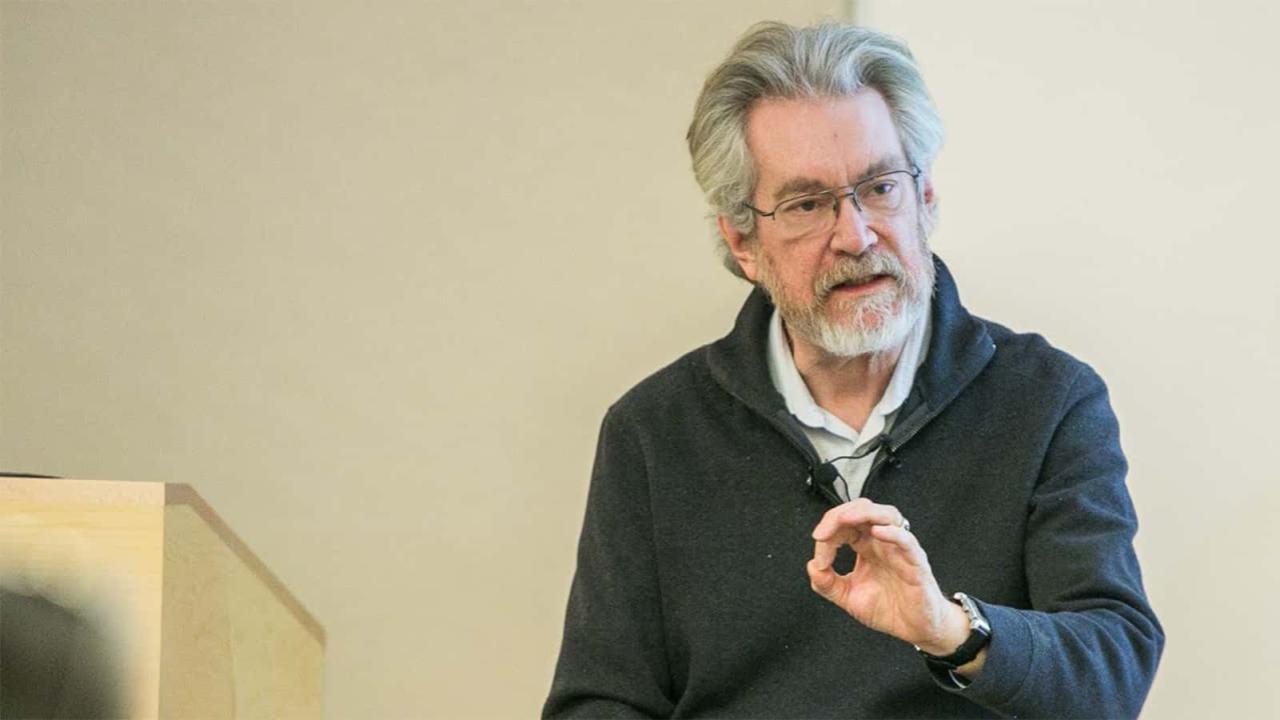
Professor Alex ‘Sandy’ Pentland has helped create and direct the MIT Media Lab and the Media Lab Asia in India, and is a HAI Fellow at Stanford.
He is one of the most-cited computational scientists in the world, and Forbes declared him one of the “7 most powerful data scientists in the world” along with Google founders and the Chief Technical Officer of the United States.
He co-led the World Economic Forum discussion in Davos that led to the EU privacy regulation GDPR, and was one of the UN Secretary General’s “Data Revolutionaries” helping to forge the transparency and accountability mechanisms in the UN’s Sustainable Development Goals.
He has received numerous awards and distinctions such as MIT’s Toshiba endowed chair, election to the U.S. Academy of Engineering, the McKinsey Award from Harvard Business Review, the 40th Anniversary of the Internet from DARPA, and the Brandeis Award for work in privacy.
Source: MIT Website
About
He is a member of advisory boards for the UN Secretary General, the UN Foundation, Consumers Union, and formerly the OECD, American Bar Association, Google, AT&T, and Nissan. He is a member of the U.S. National Academy of Engineering and council member within the World Economic Forum.
Companies co-founded or incubated by Pentland’s lab include the largest rural health care service delivery system in the world , the news and advertising arm of Alibaba , the identity authentication technology that powers India’s digital identity system Aadahar, and rural service outlets for India’s largest payment solutions provider .
More recent spin-off companies include Ginger.io (mental health services), CogitoCorp.com (AI coaching for interaction management), Wise Systems (delivery planning and optimization), Sila Money (stable bank and coin), Akoya (secure, privacy-preserving financial interactions), and Prosperia (Fairness and bias mitigation for social services throughout Latin America), and Array Insights (federated medical data analytics).
Over the years Sandy has advised more than 80 PhD students. Almost half are now tenured faculty at leading institutions, with another one-quarter leading industry research groups and a final quarter founders of their own companies. Together Sandy and his students have pioneered computational social science, organizational engineering, wearable computing (Google Glass), image understanding, and modern biometrics. His most recent books are Building the New Economy and Trusted Data, both published by MIT Press, Social Physics, published by Penguin Press, and Honest Signals, published by MIT Press.
Interesting experiences include dining with British Royalty and the President of India, staging fashion shows in Paris, Tokyo, and New York, and developing a method for counting beavers from space.
Biography
 Professor Alex ‘Sandy’ Pentland has helped create and direct the MIT Media Lab and the Media Lab Asia in India, and is a HAI Fellow at Stanford. He is one of the most-cited computational scientists in the world, and Forbes declared him one of the “7 most powerful data scientists in the world” along with Google founders and the Chief Technical Officer of the United States. He co-led the World Economic Forum discussion in Davos that led to the EU privacy regulation GDPR, and was one of the UN Secretary General’s “Data Revolutionaries” helping to forge the transparency and accountability mechanisms in the UN’s Sustainable Development Goals. He has received numerous awards and distinctions such as MIT’s Toshiba endowed chair, election to the U.S. Academy of Engineering, the McKinsey Award from Harvard Business Review, the 40th Anniversary of the Internet from DARPA, and the Brandeis Award for work in privacy. Recent invited keynotes include annual meetings of OECD, G20, World Bank, and JP Morgan.
He is a member of advisory boards for the UN Secretary General, the UN Foundation, Consumers Union, and formerly the OECD, American Bar Association, Google, AT&T, and Nissan. He is a member of the U.S. National Academy of Engineering and council member within the World Economic Forum.
Companies co-founded or incubated by Pentland’s lab include the largest rural health care service delivery system in the world , the news and advertising arm of Alibaba , the identity authentication technology that powers India’s digital identity system Aadahar, and rural service outlets for India’s largest payment solutions provider .
More recent spin-off companies include Ginger.io (mental health services), CogitoCorp.com (AI coaching for interaction management), Wise Systems (delivery planning and optimization), Sila Money (stable bank and coin), Akoya (secure, privacy-preserving financial interactions), and Prosperia (Fairness and bias mitigation for social services throughout Latin America), and Array Insights (federated medical data analytics).
Over the years Sandy has advised more than 80 PhD students. Almost half are now tenured faculty at leading institutions, with another one-quarter leading industry research groups and a final quarter founders of their own companies. Together Sandy and his students have pioneered computational social science, organizational engineering, wearable computing (Google Glass), image understanding, and modern biometrics. His most recent books are Building the New Economy and Trusted Data, both published by MIT Press, Social Physics, published by Penguin Press, and Honest Signals, published by MIT Press.
Interesting experiences include dining with British Royalty and the President of India, staging fashion shows in Paris, Tokyo, and New York, and developing a method for counting beavers from space.
Source: MIT
Web Links
Videos
Skip navigation Alex Pentland Create 1 Avatar image Alex “Sandy” Pentland and Lisa Kay Solomon — Shared Wisdom: Cultural Evolution in the Age of AI
February 20, 2026 (01:00:34)
By: Family Action Network
In “Shared Wisdom: Cultural Evolution in the Age of AI,” Alex “Sandy” Pentland, Ph.D., delves into the history of innovation, emphasizing how technologies and cultural inventions have shaped human society. Humanity’s great leaps forward—the rise of civilizations, the Enlightenment, and the Scientific Revolution—were all propelled by cultural inventions that accelerated our rate of innovation and built collective wisdom. Solving today’s global challenges, from climate change and pandemics to failing social institutions, will require similarly fundamental inventions.
“Shared Wisdom” provides a unique perspective on human society and offers insights into how we can use technologies like digital media and AI to augment, rather than replace, our human capacity for deliberation. Drawing on his expertise in both social science and technology, Pentland bridges the gap between these disciplines and offers a holistic view of the challenges and opportunities we face in the age of AI. By examining our deep history, he argues that the better we understand the key factors that accelerate cultural evolution, the greater our chances of surmounting our current problems.
Pentland is a Fellow at the Stanford Institute for Human-Centered AI and Toshiba Professor of Media Arts & Science at MIT’s Sloan School of Management. He is a serial entrepreneur, was named one of the “100 People to Watch This Century” by Newsweek and “one of the seven most powerful data scientists in the world” by Forbes. He is a member of the U.S. National Academy of Engineering, an advisor to Abu Dhabi Investment Authority Lab, and an advisor to Google, AT&T, and the UN Secretary General.
Pentland will be in conversation with Lisa Kay Solomon (FAN ’24), a lecturer and the Futurist in Residence at the Stanford University d.school. She is the host of the “How We Future” podcast and Substack and the co-author of the bestselling books “Moments of Impact” and “Design a Better Business.”
Wikipedia
Alex Paul "Sandy" Pentland (born 1951) is an American computer scientist, HAI Fellow at Stanford, Toshiba Professor at MIT, and serial entrepreneur.
Education
Pentland received his bachelor's degree from the University of Michigan, and his Ph.D. from Massachusetts Institute of Technology in 1982.
Career
Pentland started as a lecturer at Stanford University in both computer science and psychology, and joined the MIT faculty in 1986, where he became academic head of the Media Laboratory and received the Toshiba Chair in Media Arts and Sciences, later joined the faculty of the MIT School of Engineering and the MIT Sloan School. He most recently became HAI Fellow at Stanford, leading Digital Democracy and Loyal AI Agents initiatives.
Pentland serves on the advisory boards of the Luxembourg Ministry of the Economy, the Abu Dhabi Investment Authority Lab; and formerly of the UN Global Partnership for Sustainable Development Data, Consumers Union, OECD and American Bar Association, AT&T, and several of the startup companies he has co-founded. He previously co-founded and co-directed the Media Lab Asia laboratories at the Indian Institutes of Technology and Strong Hospital's Center for Future Health.
Pentland is one of the most cited authors in computer science,[1] with an h-index of 160.[2]
He is a member of the U.S. National Academy of Engineering, co-led the World Economic Forum discussion in Davos[3] that led to the EU privacy regulation GDPR, and was one of the UN Secretary General's "Data Revolutionaries" who helped forge the transparency and accountability mechanisms in the UN's Sustainable Development Goals.[4]
Pentland founded MIT Connection Science,[5] an MIT-wide program which pioneered computational social science, using big data and AI to better understand human society. He also founded the Trust::Data Alliance,[6] an alliance of companies and nations building open-source software that makes AI and data safe, trusted and secure. He also founded the MIT Media Lab Entrepreneurship Program,[7] which creates ventures to take cutting-edge technologies into the real world. He was academic director of the Data-Pop Alliance,[8] and co-founder of Imagination In Action,[9] which bring world-changing inventors together with leaders of governments and companies.
In 2011 Tim O’Reilly named him one of the world's seven most powerful data scientists,[10] along with Larry Page, then CEO of Google, and the CTO of the Department of Health and Human Services. Recent invited keynotes include annual meetings of U.S. National Academy of Engineering, OECD, G20, World Bank, and JP Morgan.
Pentland's research focuses on next-gen AI, computational social science, and cybersecurity. His research helps people better understand the "physics" of their social environment, and helps individuals, companies and communities to reinvent themselves to be safer, more productive, and more creative. He has previously been a pioneer in wearable computing,[11] ventures technology for developing nations,[12] and image understanding.[13] His research has been featured in Nature, Science, and Harvard Business Review, as well as being the focus of TV features on BBC World, Discover and Science channels.[citation needed]
Companies co-founded or incubated by Pentland's lab include the largest rural health care service delivery system in the world,[14] the advertising arm of Alibaba,[15] the identity authentication technology that powers India's digital identity system Aadhaar,[16] and rural service outlets for India's largest payment solutions provider.[17]
More recent companies include Ginger.io (mental health services), CogitoCorp.com (AI coaching for interaction management), SCRT.network (Web3 confidential smart contracts), Wise Systems (delivery planning and optimization), Sila Money (stable bank and stablecoin), Akoya (secure, privacy-preserving financial interactions), FortifID (digital identity), Alphabiome.ai (microbiome interventions for health), and Array Insights (federated medical data analytics).[citation needed]
Pentland, along with colleagues William J. Mitchell and Kent Larson at the Massachusetts Institute of Technology, are credited with first exploring the concept of a living laboratory. They argued that a living lab represents a user-centric research methodology for sensing, prototyping, validating and refining complex solutions in multiple and evolving real life contexts. Nowadays, several living lab descriptions and definitions are available from different sources.[18][19][20][21][22][23]
Publications
- Honest Signals (2010)[24] describes research chosen as Harvard Business Review Breakthrough Idea of the Year.[25]
- Social Physics (2015)[26] describes research that won both the McKinsey Award from Harvard Business Review[27] and the 40th Anniversary of the Internet Grand Challenge.[28]
- Shared Wisdom (2025) describes how AI can be safely combined with human intelligence to create a more innovative, fair, and flourishing society.
References
- ↑ "Alex 'Sandy' Pentland".
- ↑ "Alex 'Sandy' Pentland". Google Scholar. Retrieved February 7, 2021.
- ↑ "New Deal on Data, World Economic Forum" (PDF). Media Lab. Massachusetts Institute of Technology. Retrieved April 4, 2019.
- ↑ "A World That Counts, UN Data Revolution" (PDF). www.undatarevolution.org. United Nations. Retrieved April 4, 2019.
- ↑ "MIT Connection Science". MIT Connection Science. Massachusetts Institute of Technology. Retrieved March 7, 2018.
- ↑ "MIT Trust::Data Alliance".
- ↑ MIT Media Lab Entrepreneurship Program
- ↑ "Home". Data-Pop Alliance. Retrieved 2016-01-18.
- ↑ "Home". Imagination In Action. Retrieved 2021-02-21.
- ↑ Perlroth, Nicole. "#6 Alex". Forbes.
- ↑ Feinleib, Dave. "3 Big Data Insights from the Grandfather of Google Glass". Forbes.
- ↑ "D-Lab - Development through Dialogue, Design and Dissemination".
- ↑ "Scientific American Frontiers - PBS Programs - PBS". PBS. Archived from the original on 2015-09-24. Retrieved 2017-08-24.
- ↑ "spinoff". Dimagi. Retrieved 7 January 2021.
- ↑ "spinoff". Reuters. 14 January 2015. Retrieved 7 January 2021.
- ↑ "spinoff". ASMag. Retrieved 7 January 2021.
- ↑ "spinoff". Medianama. 16 August 2012. Retrieved 7 January 2021.
- ↑ Core Labs (2006), https://web.archive.org/web/20060716231548/http://www.ami-communities.net/wiki/CORELABS.
- ↑ Niitamo, V.-P.; Kulkki, S.; Eriksson, M.; Hribernik, K. A.: State-of-the-art and good practice in the field of living labs, Proceedings of the 12th International Conference on Concurrent Enterprising: Innovative Products and Services through Collaborative Networks, Milan, Italy, 2006, 349-357.
- ↑ Pallot, M; Trousse, B.; Prinz, W.;Richir, S.; de Ruyter, B.;Rerolle, O.: Katzy, B.;Senach, B.: Living Labs Research. ECOSPACE Special Issue Newsletter 5 dedicated to Living Labs, pages 15–22. http://www.ami-communities.eu/wiki/ECOSPACE_Newsletter_No_5#Living_Labs_Research Archived 2012-09-02 at the Wayback Machine
- ↑ Schumacher, J.; Feurstein, K.: Living labs – a new multi-stakeholder approach to user integration, Presented at the 3rd International Conference on Interoperability of Enterprise Systems and Applications (I-ESA'07), Funchal, Madeira, Portugal, 2007.
- ↑ Kusiak, A., The University of Iowa, "Innovation: The Living Laboratory Perspective", Computer-Aided Design & Applications, Vol. 4, No. 6, 2007, pp 863–876
- ↑ European Commission Information Society and Media, Unit F4 New Infrastructure Paradigms and Experimental Facilities. Living Labs for user-driven open innovation. An overview of the Living Labs methodology, activities and achievements. January 2009.
- ↑ Pentland, Alex (24 September 2010). Honest Signals: How They Shape Our World. The MIT Press. ISBN 978-0262515122.
- ↑ "Harvard Business Review - Ideas and Advice for Leaders".
- ↑ Social Physics: How social networks can make us smarter. Penguin Press. 27 January 2015. ISBN 9780143126331. Retrieved 1 September 2019.
- ↑ "The 2012 McKinsey Award Winners". Harvard Business Review. April 2013.
- ↑ "MIT News Press Center - MIT News".