Summary
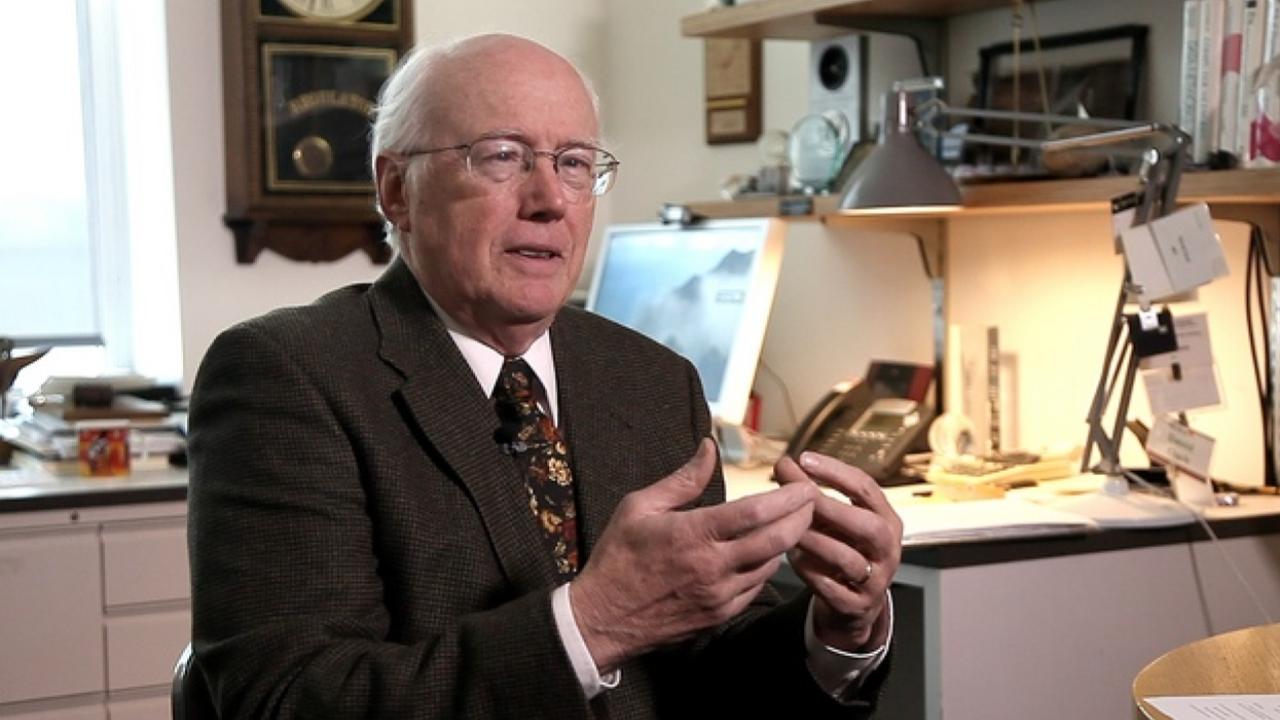
David Clark is a Senior Research Scientist at the MIT Computer Science and Artificial Intelligence Laboratory. Since the mid-70s, he has been leading the development of the Internet; from 1981-1989 he acted as Chief Protocol Architect in this development, and chaired the Internet Activities Board. His design research looks at re-definition of the architectural underpinnings of the Internet, and the relation of technology and architecture to economic, societal and policy considerations. He supported the U.S. National Science Foundation Future Internet Architecture program.
His current priorities include Internet security, the challenges of large-scale collection and curation of data about the Internet, and mitigating the abusive uses of Internet applications. He is past chairman of the Computer Science and Telecommunications Board of the National Academies, and has contributed to a number of studies on the societal and policy impact of computer communications. He is a Fellow of the National Academy of Engineering and the American Academy of Arts and Sciences.
Source: MIT Website
About
Biography
David Clark is a Senior Research Scientist at the MIT Computer Science and Artificial Intelligence Laboratory. Since the mid-70s, he has been leading the development of the Internet; from 1981-1989 he acted as Chief Protocol Architect in this development, and chaired the Internet Activities Board. His design research looks at re-definition of the architectural underpinnings of the Internet, and the relation of technology and architecture to economic, societal and policy considerations.
He supported the U.S. National Science Foundation Future Internet Architecture program. His current priorities include Internet security, the challenges of large-scale collection and curation of data about the Internet, and mitigating the abusive uses of Internet applications.
He is past chairman of the Computer Science and Telecommunications Board of the National Academies, and has contributed to a number of studies on the societal and policy impact of computer communications. He is a Fellow of the National Academy of Engineering and the American Academy of Arts and Sciences.
Source: CSAIL at MIT
Web Links
Videos
Three Directions in Design: David Clark
March 7, 2024 (29:07)
By: MIT Schwarzman College of Computing
David Clark, Senior Research Scientist at MIT CSAIL, and author of the book Designing an Internet, on the role and implications of design in the context of the Internet.
Clark’s talk was part of the session on “Three Directions in Design” for the Expanding Horizons in Computing series. Organized by MIT faculty, the series of bootcamps, workshops, short talks, panels, and roundtable discussions delved into exciting areas of computing and AI, with topics ranging from security, intelligence, and deep learning to design, sustainability, and policy.
Watch more videos from the MIT Schwarzman College of Computing:  / @mitcomputing
The mission of the MIT Schwarzman College of Computing is to address the opportunities and challenges of the computing age — from hardware to software to algorithms to artificial intelligence — by transforming the capabilities of academia in three key areas: strengthen core computer science and AI; infuse the forefront of computing with disciplines across MIT; and advance social, ethical, and policy dimensions of computing. Learn more at computing.mit.edu.
Wikipedia
David Dana "Dave" Clark (born April 7, 1944) is an American computer scientist and Internet pioneer who has been involved with Internet developments since the mid-1970s. He currently works as a senior research scientist at MIT's Computer Science and Artificial Intelligence Laboratory (CSAIL).[1]
Education
Clark graduated from Swarthmore College in 1966. In 1968, he received his master's and engineer's degrees in electrical engineering from MIT, where he worked on the I/O architecture of Multics under Jerry Saltzer. He received his Ph.D. in electrical engineering from MIT in 1973.
Career
From 1981 to 1989, Clark acted as chief protocol architect in the development of the Internet, and chaired the Internet Activities Board, which later became the Internet Architecture Board. He has also served as chairman of the Computer Sciences and Telecommunications Board of the National Research Council.
In 1990 he was awarded the SIGCOMM Award in recognition of his major contributions to Internet protocol and architecture. Clark received in 1998 the IEEE Richard W. Hamming Medal.[2]
In 1996, Clark was elected a member of the National Academy of Engineering for the design and development of efficient implementation techniques for Internet protocols. In 1998, he was elevated to Fellow of the IEEE for leadership in the engineering and deployment of the protocols that embody the Internet.[3] In 2001, he was inducted as a Fellow of the Association for Computing Machinery.
Also in 2001, he was awarded the Telluride Tech Festival Award of Technology in Telluride, Colorado, and in 2011 the Internet & Society Lifetime Achievement Award from the Oxford Internet Institute at the Oxford University. In 2013, he was inducted into the Internet Hall of Fame.[4]
His recent research interests include what the architecture of the Internet will look like in the post-PC era as well as "extensions to the Internet to support real-time traffic, explicit allocation of service, pricing and related economic issues, and policy issues surrounding local loop employment".[1]
During the 124th IETF meeting in Montreal, Clark was awarded the Jonathan B. Postel Service Award.[5] He received the IEEE Internet Award for "groundbreaking contributions and steadfast advocacy in promoting an integrated perspective on the Internet's technical, policy, legal, and economic development"[6] at the 2026 edition of the IEEE Security and Privacy Symposium.[7]
Legacy
Clark has been credited with a popular statement in the computer science realm:[8]
We reject: kings, presidents, and voting. We believe in: rough consensus and running code.
— David D. Clark (1992)
In 1999, law professor Lawrence Lessig stated that "rough consensus and running code" had broad significance as "a manifesto that will define our generation.'[8] Clark's new ethos of consensus has become a widely used methodology software development today and replaced a more top down approach that existed in the 80s.
Selected publications
- David D. Clark, "An Input/Output Architecture for Virtual Memory Computer Systems", Ph.D. dissertation, Project MAC Technical Report 117, January 1974
- Saltzer, J. H.; Reed, D. P.; Clark, D. D. (April 8–10, 1981). End-to-End Arguments in System Design. Second International Conference on Distributed Computing Systems. Paris: IEEE Computer Society. pp. 509–512.
- David D. Clark, "The Design Philosophy of the DARPA Internet Protocols", Computer Communications Review 18:4, August 1988, pp. 106–114
- Clark, David D.; Shenker, Scott; Zhang, Lixia (October 1992). "Supporting real-time applications in an Integrated Services Packet Network: architecture and mechanism". ACM SIGCOMM Computer Communication Review. 22 (4). Association for Computing Machinery: 14–26. doi:10.1145/144191.144199. Retrieved February 17, 2025.
- R. Braden, David D. Clark, S. Shenker, and J. Wroclawski, "Developing a Next-Generation Internet Architecture", ISI white paper, 2000
- L. W. McKnight, W. Lehr, David D. Clark (eds.), Internet Telephony, MIT Press, 2001,ISBN 0-262-13385-7
- David D. Clark, K. Sollins, J. Wroclawski, R. Braden, "Tussle in Cyberspace: Defining Tomorrow’s Internet", Proceedings of SIGCOMM 2002, ACM Press, 2002
- David D. Clark, K. Sollins, J. Wroclawski, and T. Faber, "Addressing Reality: An Architectural Response to Real-World Demands on the Evolving Internet", ACM SIGCOMM 2003 Workshops, Karlsruhe, August 2003
Notes
- 1 2 "David Clark". Massachusetts Institute of Technology. Retrieved April 4, 2014.
- ↑ "IEEE Richard W. Hamming Medal Recipients" (PDF). IEEE. Archived from the original (PDF) on June 20, 2010. Retrieved May 29, 2011.
- ↑ "IEEE Fellows 1998 | IEEE Communications Society".
- ↑ "David Clark". Internet Hall of Fame. Internet Society. Retrieved June 30, 2023.
- ↑ "2025 Postel Awardee David Clark, an Architect and Implementer of the Internet". Internet Society. Retrieved November 5, 2025.
- ↑ "IEEE Internet Award Recipients" (PDF). IEEE. Retrieved May 19, 2026.
- ↑ "2026 Program for IEEE Security and Privacy Symposium, Awards Session". IEEE. Retrieved May 19, 2026.
- 1 2 "'Rough Consensus and Running Code' and the Internet-OSI Standards War" (PDF). Duke University. Retrieved November 17, 2019.
External links
- David D. Clark's official biography
- List of online papers of David D. Clark
- MIT homepage of David D. Clark featuring publication list, working papers, biography, etc.
- David D. Clark at the Mathematics Genealogy Project