Summary
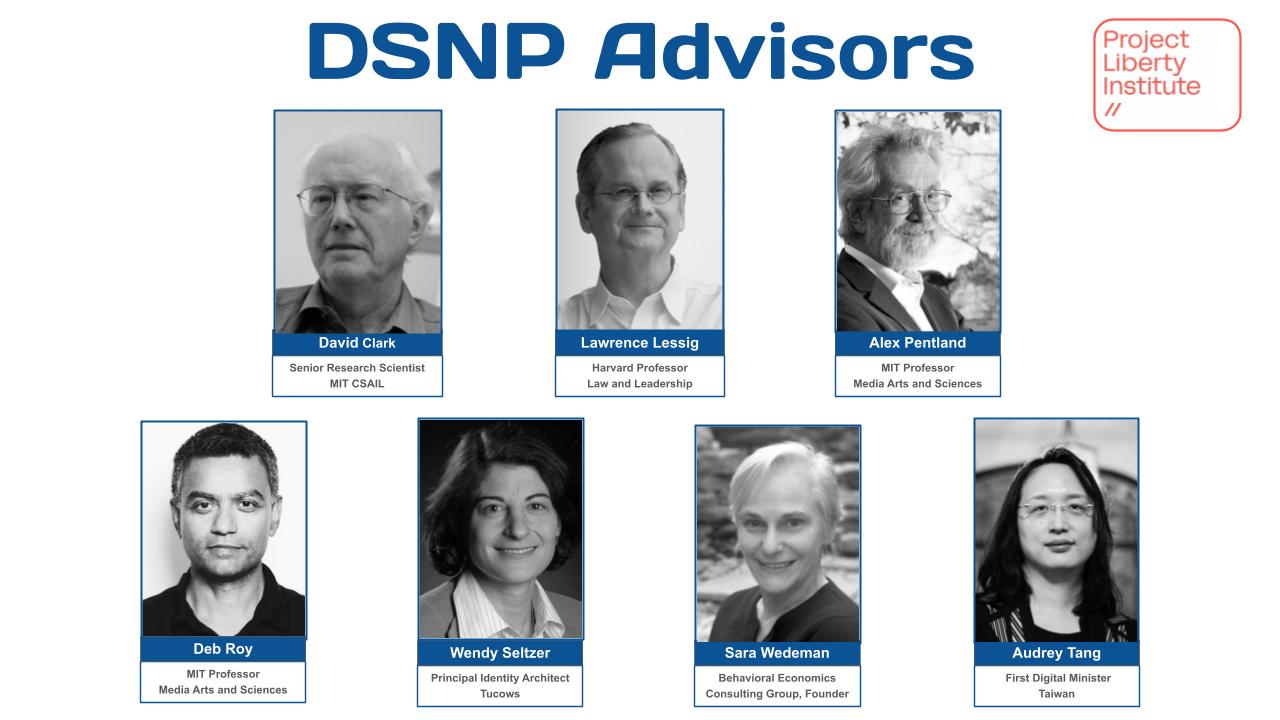
The DSNP Advisors assist the Project Liberty Institute with its research into Decentralized Social Network Protocols.
CURRENT ADVISORS
David Clark is a Senior Research Scientist at the MIT Computer Science and Artificial Intelligence Laboratory.
Lawrence Lessig is the Roy L. Furman Professor of Law and Leadership at Harvard Law School.
Alex ‘Sandy’ Pentland has helped create and direct the MIT Media Lab and the Media Lab Asia in India, and is a HAI Fellow at Stanford.
Deb Roy is professor of Media Arts and Sciences at MIT where he directs the MIT Center for Constructive Communication (CCC).
Wendy Seltzer is a lawyer and technologist, currently consulting through the Law Office of Wendy Seltzer
Audrey Tang is a Taiwanese politician and free software programmer who served as the first Minister of Digital Affairs of Taiwan from August 2022 to May 2024.
In this post are short summaries of each DSNP Advisor with a link to a profile post with more detailed information
OnAir Post: DSNP Advisors
Advisors
David Clark
Source: People’s Internet
 David Clark is a Senior Research Scientist at the MIT Computer Science and Artificial Intelligence Laboratory. Since the mid-70s, he has been leading the development of the Internet; from 1981-1989 he acted as Chief Protocol Architect in this development, and chaired the Internet Activities Board. His design research looks at re-definition of the architectural underpinnings of the Internet, and the relation of technology and architecture to economic, societal and policy considerations. He supported the U.S. National Science Foundation Future Internet Architecture program.
His current priorities include Internet security, the challenges of large-scale collection and curation of data about the Internet, and mitigating the abusive uses of Internet applications. He is past chairman of the Computer Science and Telecommunications Board of the National Academies, and has contributed to a number of studies on the societal and policy impact of computer communications. He is a Fellow of the National Academy of Engineering and the American Academy of Arts and Sciences.
Lawrence Lessig
Source: People’s Internet
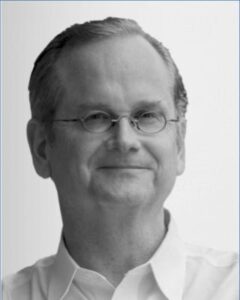 Lawrence Lessig is the Roy L. Furman Professor of Law and Leadership at Harvard Law School. Prior to returning to Harvard, he taught at Stanford Law School, where he founded the Center for Internet and Society, and at the University of Chicago. He clerked for Judge Richard Posner on the 7th Circuit Court of Appeals and Justice Antonin Scalia on the United States Supreme Court.
Lessig is the founder of Equal Citizens and a founding board member of Creative Commons, and serves on the Scientific Board of AXA Research Fund. A member of the American Academy of Arts and Sciences and the American Philosophical Society, he has received numerous awards including a Webby, the Free Software Foundation’s Freedom Award, Scientific American 50 Award, and Fastcase 50 Award.
Once cited by The New Yorker as “the most important thinker on intellectual property in the Internet era,” Lessig has turned his focus from law and technology to “institutional corruption”—relationships which, while legal, weaken public trust in an institution—especially as that affects democracy.
His books are: They Don’t Represent Us: Reclaiming Our Democracy (November 2019), Fidelity & Constraint: How the Supreme Court Has Read the American Constitution (May 2019), America, Compromised (2018), Republic, Lost v2 (2015), The USA is Lesterland (2014), One Way Forward (2012), Republic, Lost: How Money Corrupts Congress—and a Plan to Stop It (2011), Remix: Making Art and Commerce Thrive in the Hybrid Economy (2008), Code v2 (2006), Free Culture (2004), The Future of Ideas (2001), and Code and Other Laws of Cyberspace (1999).
Lessig holds a BA in economics and a BS in management from the University of Pennsylvania, an MA in philosophy from Cambridge University, and a JD from Yale.
Alex Pentland
Source: People’s Internet
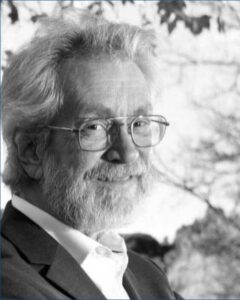 Professor Alex ‘Sandy’ Pentland has helped create and direct the MIT Media Lab and the Media Lab Asia in India, and is a HAI Fellow at Stanford. He is one of the most-cited computational scientists in the world, and Forbes declared him one of the “7 most powerful data scientists in the world” along with Google founders and the Chief Technical Officer of the United States. He co-led the World Economic Forum discussion in Davos that led to the EU privacy regulation GDPR, and was one of the UN Secretary General’s “Data Revolutionaries” helping to forge the transparency and accountability mechanisms in the UN’s Sustainable Development Goals. He has received numerous awards and distinctions such as MIT’s Toshiba endowed chair, election to the U.S. Academy of Engineering, the McKinsey Award from Harvard Business Review, the 40th Anniversary of the Internet from DARPA, and the Brandeis Award for work in privacy. Recent invited keynotes include annual meetings of OECD, G20, World Bank, and JP Morgan.
He is a member of advisory boards for the UN Secretary General, the UN Foundation, Consumers Union, and formerly the OECD, American Bar Association, Google, AT&T, and Nissan. He is a member of the U.S. National Academy of Engineering and council member within the World Economic Forum.
Companies co-founded or incubated by Pentland’s lab include the largest rural health care service delivery system in the world , the news and advertising arm of Alibaba , the identity authentication technology that powers India’s digital identity system Aadahar, and rural service outlets for India’s largest payment solutions provider .
More recent spin-off companies include Ginger.io (mental health services), CogitoCorp.com (AI coaching for interaction management), Wise Systems (delivery planning and optimization), Sila Money (stable bank and coin), Akoya (secure, privacy-preserving financial interactions), and Prosperia (Fairness and bias mitigation for social services throughout Latin America), and Array Insights (federated medical data analytics).
Over the years Sandy has advised more than 80 PhD students. Almost half are now tenured faculty at leading institutions, with another one-quarter leading industry research groups and a final quarter founders of their own companies. Together Sandy and his students have pioneered computational social science, organizational engineering, wearable computing (Google Glass), image understanding, and modern biometrics. His most recent books are Building the New Economy and Trusted Data, both published by MIT Press, Social Physics, published by Penguin Press, and Honest Signals, published by MIT Press.
Interesting experiences include dining with British Royalty and the President of India, staging fashion shows in Paris, Tokyo, and New York, and developing a method for counting beavers from space.
Deb Roy
Source: People’s Internet
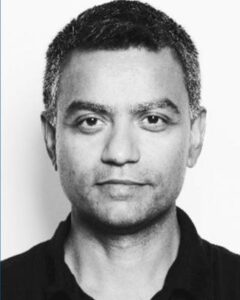 Deb Roy is professor of Media Arts and Sciences at MIT where he directs the MIT Center for Constructive Communication (CCC). He leads research in designing human-AI systems that foster dialogue, listening, and deliberation in ways that build civic muscle. Roy is also co-founder and unpaid CEO of Cortico, a closely affiliated nonprofit collaborator of CCC that develops, operates and supports a conversation platform designed to surface underheard voices and perspectives and create scalable dialogue networks.
Roy serves on the board of the Knight First Amendment Institute, the FRONTLINE advisory council, and is a faculty associate at the Berkman Klein Center for Internet & Society at Harvard University.
Previously, Roy was a visiting professor at Harvard Law School (2021-22), and served as executive director of the MIT Media Lab (2019-2021), where CCC is based. He has served on the Knight Commission on Trust, Media, and Democracy and the Aspen Institute’s Commission on Information Disorder.
While on leave from MIT, Roy co-founded and was CEO of Bluefin Labs, a media analytics company that analyzed the interactions between television and social media at scale. Bluefin was acquired by Twitter in 2013, Twitter’s largest acquisition to date. From 2013-2017 Roy served as Twitter’s chief media scientist.
Roy is the author of over 185 academic papers including a study of the spread of false news that was the cover story of Science magazine in 2018 and cited as one of the most influential academic publications of the year. His 2023 essay in The Atlantic describes his journey from studying social media to creating dialogue networks, his 2024 Atlantic essay explores ways to tackle truth decay, and his 2026 Atlantic essay diagnoses the accountability gap opened AI chatbots. Roy’s widely viewed TED talk Birth of a Word presents his pioneering research on his son’s language development that led to new ideas in media analytics.
A native of Canada, Deb was born and raised in Winnipeg and spent large parts of his childhood in Calcutta. He received his Bachelor of Applied Science from the University of Waterloo and PhD in Media Arts and Sciences from MIT.
Selected publications:
Wendy Seltzer
Source: People’s Internet
 Wendy Seltzer is a lawyer and technologist, currently consulting through the Law Office of Wendy Seltzer.
As Principal Identity Architect at Tucows, she helped to found the Arya Association for interoperable trust and identity recognition. She previously served as Strategy Lead and Counsel to the World Wide Web Consortium (W3C) at MIT, improving the Web’s security, availability, and interoperability through standards. As a Fellow with Harvard’s Berkman Klein Center for Internet & Society, Wendy founded the Lumen Project (formerly Chilling Effects Clearinghouse), the web’s pioneering transparency report to measure the impact of legal takedown demands online. Wendy co-authored the second edition of Blown to Bits: Your Life, Liberty, and Happiness After the Digital Explosion. She seeks to improve technology policy in support of user-driven innovation and secure communication.
Sara Wedeman
Source: People’s Internet
 Sara holds a Ph.D. in Professional Psychology from the University of Pennsylvania, Masters’ degrees from the University of Pennsylvania and Bryn Mawr College, and a B.A. from Swarthmore College as well as a certificate in Business Administration from the Wharton Graduate School.
She is very interested in emerging technologies, particularly the social aspects of their adoption and use. An expert at working with and making sense of quantitative data, Sara is equally skilled at grasping the subtleties of personality and organizational culture. Her unique professional background, together with her extensive overseas experience, enable Sara to see and sense things others do not. Thus, she helps clients craft novel and effective strategies, while remaining true to their identities and aspirations. She particularly enjoys working with clients on emerging issues, where innovation is not an option but a necessity.
Audrey Tang
Source: People’s Internet
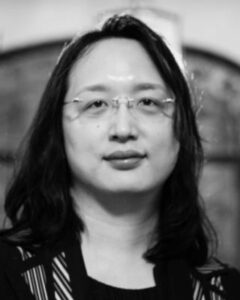 Audrey Tank is a Taiwanese politician and free software programmer who served as the first Minister of Digital Affairs of Taiwan from August 2022 to May 2024.
A globally recognised civic-tech leader and the world’s first openly non-binary cabinet minister, Ambassador Audrey Tang has been instrumental in positioning Taiwan at the forefront of internet freedom and civic participation.
TIME named Tang to its inaugural “100 Most Influential People in AI” list in 2023 for her profound impact on leveraging technology for public good.
Tang was a key contributor to the g0v.tw civic tech community, an initiative that promotes transparency by “forking” government websites into open-source versions preferred by citizens. During the 2014 Sunflower Movement, Tang played a critical role in livestreaming protests against a controversial trade pact, transforming deliberation into a public act of courage, cementing Taiwan’s reputation as Asia’s beacon of freedom.